Klassifizierung / Names
Namen | Synonyme | Catalog of Fishes(Gattung, Arten) | ITIS | CoL | WoRMS | Cloffa
>
Gobiiformes (Gobies) >
Gobiidae (Gobies) > Gobiinae
Etymology: stevcici: Named for Zdravko Stevčić.
Eponymy: Zdravko Števčić (1931–2018) was a Croatian biologist who graduated (1956) and earned his PhD (1965) at the Faculty of Natural Sciences and Mathematics in Zagreb. [...] (Ref. 128868), visit book page.
Umwelt: Milieu / Klimazone / Tiefenbereich / Verbreitungsgebiet
Ökologie
seewasser benthopelagisch; tiefenbereich 15 - 40 m (Ref. 75175). Tropical
Eastern Central Atlantic: São Tomé Islands, Gulf of Guinea.
Größe / Gewicht / Alter
Geschlechtsreife: Lm ? range ? - ? cm
Max length : 3.3 cm SL Männchen/unbestimmt; (Ref. 75175); 2.3 cm SL (female)
Kurzbeschreibung
Bestimmungsschlüssel | Morphologie | Morphometrie
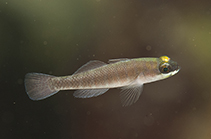
Rückenflossenstacheln (insgesamt) : 7; Rückenflossenweichstrahlen (insgesamt) : 11; Afterflossenstacheln: 1; Afterflossenweichstrahlen: 9. This species is distinguished from G. nigricintus by the following characters: presence of pore ß; row g anteriorly ends more or less in front of row o; presence of transverse interorbital row p; snout with 4 median preorbital rows (vs. 3); 37-41 longitudinal scale rows (vs. 29-33); 22-24 predorsal scales (vs. 18); 9 anal fin rays (vs. 10-11); 17 pectoral fin rays (vs. 18-20); body overall light reddish-brown, with or without faint brown vertical bands (vs. dark brown bars contrasting strongly with light ground on flanks, fins, eyes, head and lips) (Ref. 75175).
Body shape (shape guide): fusiform / normal; Cross section: oval.
Types were collected between 15 and 25 m depth, but otherwise observed at entrances of small caves between 20 and 40 m depth. Small individuals (about 4 cm SL) were seen at Rolas Island in 20 m depth hovering upside down; individuals of approximately twice this size were reported in small caves between 35 to 40 m depth at Diogo Vaz (Ref. 75175).
Lebenszyklus und Paarungsverhalten
Geschlechtsreife | Fortpflanzung | Ablaichen | Eier | Fruchtbarkeit | Larven
Kovačić, M. and U.K. Schliewen, 2008. A new species of Gorogobius (Perciformes: Gobiidae) from São Tomé Islands. Zootaxa 1686:29-36. (Ref. 75175)
IUCN Rote Liste Status (Ref. 130435: Version 2025-2 (Global))
Bedrohung für Menschen
Harmless
Nutzung durch Menschen
Tools
Zusatzinformationen
Download XML
Internet Quellen
Schätzungen auf der Grundlage von Modellen
Phylogenetischer Diversitätsindex (Ref.
82804): PD
50 = 0.7500 [Uniqueness, from 0.5 = low to 2.0 = high].
Bayesian length-weight: a=0.01023 (0.00477 - 0.02194), b=3.01 (2.83 - 3.19), in cm total length, based on LWR estimates for this (Sub)family-body shape (Ref.
93245).
Trophische Ebene (Ref.
69278): 3.1 ±0.3 se; based on size and trophs of closest relatives
Widerstandsfähigkeit (Ref.
120179): hoch, Verdopplung der Population dauert weniger als 15 Monate. (Preliminary K or Fecundity.).
Anfälligkeit der Fischerei (Ref.
59153): Low vulnerability (10 of 100).
🛈