>
Perciformes/Cottoidei (Sculpins) >
Liparidae (Snailfishes)
Etymology: Careproctus: Greek, kara = face + Greek, proktos = anus (Ref. 45335); rotundifrons: Name from Latin ‘rotund’ for rounded and ‘frons’ meaning front; refers to its rounded forehead.
Environnement : milieu / zone climatique / profondeur / gamme de distribution
Écologie
marin bathydémersal; profondeur 521 - 1100 m (Ref. 75204). Deep-water; 38°N - 34°N, 138°E - 142°E (Ref. 75204)
Northwest Pacific: Japan.
Taille / Poids / Âge
Maturité: Lm ? range ? - ? cm
Max length : 10.8 cm SL mâle / non sexé; (Ref. 75204); 104.4 cm SL (female)
Description synthétique
Clés d'identification | Morphologie | Morphométrie
Rayons mous dorsaux (Total) : 47 - 50; Rayons mous anaux: 41 - 45; Vertèbres: 53 - 56. This species is distinguished by the following characters: D 47-50; A 41-45; pectoral-fin rays 34-40; vertebrae 10-11+42-46=53-56; eye diameter 5.6-7.2% SL; disk length 4.6-7.1% SL; interorbital width 9.9-13.5% SL; outer margin of pectoral fin is slightly notched; pectoral radials 4 (3+1) without notches; ribs 2-3; scapula notch present; pyloric caeca 15-29; dark brown peritoneum; pale colored stomach, oral cavity, and pyloric caeca (Ref. 75204).
Body shape (shape guide): elongated.
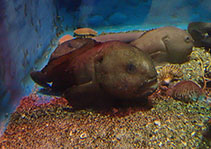
Mature and immature specimens were captured by bait traps on the sea floor; apparently benthic. This is observed to swim searching for food fallen on the bottom and frequently to stay on the acrylic glass or walls of a tank using the ventral disk from individuals on display at Tokyo Sea Life Park. Captured together with A holosaurid (Aldrovandia affinis), a psychrolutid (Ebinania vermiculata), and 2 zoarcids (Ericandersonia sagamia and Japonolycodes abei) in the same traps in Sagami Bay, indicating the likelihood of their sharing similar habitat. Females have an ovipositor in the abdominal cavity and it is everted to outside the body when the abdominal cavity is pressed (Ref. 75204).
Cycle de vie et comportement reproducteur
Maturité | Reproduction | Frai | Œufs | Fécondité | Larves
Sakurai, H. and G. Shinohara, 2008. Careproctus rotundifrons, a new snailfish (Scorpaeniformes: Liparidae) from Japan. Bull. Natl. Mus. Nat. Sci. Ser. A. Suppl. 2:39-45. (Ref. 75204)
Statut dans la liste rouge de l'IUCN (Ref. 130435: Version 2025-2 (Global))
Menace pour l'homme
Harmless
Utilisations par l'homme
Pêcheries: sans intérêt
Outils
Articles particuliers
Télécharger en XML
Sources Internet
Estimations basées sur des modèles
Indice de diversité phylogénétique (Réf.
82804): PD
50 = 0.5000 [Uniqueness, from 0.5 = low to 2.0 = high].
Bayesian length-weight: a=0.00447 (0.00203 - 0.00984), b=3.17 (2.99 - 3.35), in cm total length, based on LWR estimates for this Genus-body shape (Ref.
93245).
Niveau trophique (Réf.
69278): 3.5 ±0.5 se; based on size and trophs of closest relatives
Résilience (Réf.
120179): Très faible, temps minimum de doublement de population supérieur à 14 ans (Preliminary K or Fecundity.).
Vulnérabilité de la pêche (Ref.
59153): Very high vulnerability (76 of 100).
🛈