>
Siluriformes (Catfishes) >
Doradidae (Thorny catfishes) > Doradinae
Etymology: Rhinodoras: Greek, rhinos = nose + Greek, dora = skin (Ref. 45335); armbrusteri: Named for Jonathan William Armbruster, for his sterling contributions to the collection and study of neotropical fishes and for deftly leading the expedition to Guyana that resulted in the discovery of this species.
Eponymy: Dr Jonathan William Armbruster (d: 1969) is Professor and Curator of Fishes at Auburn University, Alabama. [...] (Ref. 128868), visit book page.
Lingkungan: lingkungan / zona iklim / kisaran kedalaman / jangkauan distribusi
Ekologi
; air tawar dasar (demersal). Tropical
South America: Takutu River (including its tributary, Ireng) that drains into the upper Rio Branco (Amazonas basin), Guyana and Brazil, and the Rupununi River (Essequibo basin) in Guyana.
Ukuran / Berat / umur
Kematangan: Lm ? range ? - ? cm
Max length : 9.6 cm SL jantan/; (Ref. 75166)
deskripsi pendek
Kunci identifiaksi (pengenalan) | Morfologi | Morfometrik
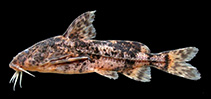
Duri punggung (Keseluruhan (total)) : 1; duri punggung lunak (Keseluruhan (total)) : 6. Differs from all nominal species of the genus Rhinodoras by the following combination of characters: heavy pigmentation on ventral surfaces with many dark speckles or larger spots on belly usually extending onto gular region; anterior midlateral plates moderately deep, depth fifth plate 26.3-29% of corresponding body depth; depths of dorsal and ventral wings of anterior plates subequal, depth of dorsal wing slightly less than twice that of ventral; midlateral plates 57-60, midlateral plates anterior to vertical through pelvic fin origin usually five; tympanal portion of lateral-line canal moderately ossified with two or three distinct plates, posterior-most largest with low medial ridge or thorn and moderately developed wings with serrated margins; postcleithral process moderately short and broad, depth 36.8-44.3% of length; adipose eyelid moderate to large, horizontal diameter 11.4-14.2% of HL; pectoral fin usually I,8; and gas bladder one-part with terminal diverticula small and fused. This fish most closely resembles Rhinodoras boehlkei and can be differentiated from this by the following features: heavy pigmentation with many dark speckles or spots on ventral surfaces more elongated postcleithral process, depth 36.8-44.3%; larger adipose eyelid, horizontal diameter 11.4-14.2%; and midlateral plates 57-60 (Ref. 75166).
Body shape (shape guide): elongated.
There were individuals encountered during the day hiding in cavities in lateritic boulders submerged in less than three meters of water. An adult specimen was observed at night in a swift shallow run over bedrock (Ref. 75166).
Siklus hidup dan perilaku kawin
Kematangan | Reproduksi, perkembang biakan | Pemijahan | telur-telur | Fekunditas | Larva
Sabaj, M.H., D.C. Taphorn and O.E. Castillo G., 2008. Two new species of thicklip thornycats, genus Rhinodoras (Teleostei: Siluriformes: Doradidae). Copeia 2008(1):209-226. (Ref. 75166)
Status IUCN Red List (Ref. 130435: Version 2025-2 (Global))
ancaman kepada manusia
Harmless
penggunaan manusia
Alat, peralatan
laporan khas
muat turun XML
Sumber internet
Estimasi berdasarkan model
Indeks keanekaragaman filogenetik (Acuan
82804): PD
50 = 0.5312 [Uniqueness, from 0.5 = low to 2.0 = high].
Bayesian length-weight: a=0.01230 (0.00587 - 0.02579), b=2.96 (2.78 - 3.14), in cm total length, based on LWR estimates for this (Sub)family-body shape (Ref.
93245).
Tingkat Trofik (Acuan
69278): 2.9 ±0.4 se; based on size and trophs of closest relatives
Daya lenting (Acuan
120179): Tinggi, Waktu penggandaan populasi minimum kurang dari 15 bulan (Preliminary K or Fecundity.).
Kerentanan Penangkapan Ikan (Ref.
59153): Low vulnerability (10 of 100).
🛈