Élasmobranches (requins et raies) (sharks and rays) >
Carcharhiniformes (Ground sharks) >
Scyliorhinidae (Cat sharks) > Scyliorhininae
Etymology: Cephaloscyllium: cephalus, from kephale (Gr.), head, referring to its very broad and depressed head; skylion, Greek for dogfish or small shark (See ETYFish); sarawakense: -ensis, Latin suffix denoting place: Sarawak, Malaysia, type locality (See ETYFish).
Environnement : milieu / zone climatique / profondeur / gamme de distribution
Écologie
marin benthopélagique; profondeur 100 - 200 m (Ref. 94801). Subtropical
Pacific Ocean: South China Sea (western south Taiwan, Hong Kong, Gulf of Tongking, Vietnam, Malaysia).
Longueur à la première maturité / Taille / Poids / Âge
Maturité: Lm 37.5, range 35 - 40 cm
Max length : 39.7 cm TL mâle / non sexé; (Ref. 75582); 44.1 cm TL (female)
Description synthétique
Clés d'identification | Morphologie | Morphométrie
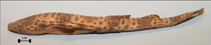
This small-sized shark is distinguished by the following characters: adults with two distinct and wide brown saddle blotches before first dorsal fin while juveniles with 3; first saddle immediately behind eye, second over posterior 1/3 of base and inner margin of pectoral fin, the third a little before first dorsal fin, which fades with growth; dark lateral circular to oblong blotches above gill openings and on lateral side of trunk; young individuals with many polka dots on body and fins; anterior nasal flap triangular without an elongate flap (Ref. 98601).
Body shape (shape guide): elongated; Cross section: angular.
All specimens were collected by trawl nets near the edge of the continental shelf (Ref. 75538).
Cycle de vie et comportement reproducteur
Maturité | Reproduction | Frai | Œufs | Fécondité | Larves
Yano, K., A. Ahmad, A.C. Gambang, A.H. Idris, A.R. Solahuddin and Z. Aznan, 2005. Sharks and rays of Malaysia and Brunei, Darussalam. SEAFDEC-MFRDMD/SP/12. Kuala Terengganu. Sharks and Rays Malaysia and Brunei:557 pp. (Ref. 75538)
Statut dans la liste rouge de l'IUCN (Ref. 130435: Version 2025-2 (Global))
Menace pour l'homme
Harmless
Utilisations par l'homme
Pêcheries: bycatch
Outils
Articles particuliers
Télécharger en XML
Sources Internet
Estimations basées sur des modèles
Température préférée (Réf.
123201): 17.5 - 23.6, mean 20.2 °C (based on 66 cells).
Indice de diversité phylogénétique (Réf.
82804): PD
50 = 0.5000 [Uniqueness, from 0.5 = low to 2.0 = high].
Bayesian length-weight: a=0.00269 (0.00140 - 0.00518), b=3.21 (3.04 - 3.38), in cm total length, based on LWR estimates for this (Sub)family-body shape (Ref.
93245).
Niveau trophique (Réf.
69278): 4.0 ±0.5 se; based on size and trophs of closest relatives
Résilience (Réf.
120179): Faible, temps minimum de doublement de population : 4,5 à 14 années (Preliminary low fecundity).
Vulnérabilité de la pêche (Ref.
59153): Low to moderate vulnerability (34 of 100).
🛈