Élasmobranches (requins et raies) (sharks and rays) >
Torpediniformes (Electric rays) >
Narkidae (Sleeper rays)
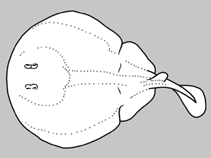
Etymology: Electrolux: Name refers to the well-developed electrogenic properties of this ray, the discovery of which sheds light (Latin 'lux') on the rich and poorly known fish diversity of the Western Indian Ocean; addisoni: Named for Mark Addison, BlueWilderness dive charters of Widenham, KwaZulu-Natal.
Eponymy: Mark Ramsay Addison (d: 1967) is the South African owner/operator of an underwater filming and expedition company ‘Blue Wilderness’ founded in 1997. [...] (Ref. 128868), visit book page.
Environnement : milieu / zone climatique / profondeur / gamme de distribution
Écologie
marin démersal; profondeur 6 - 35 m (Ref. 75572). Subtropical; 30°S - 32°S, 29°E - 31°E (Ref. 114953)
Western Indian Ocean: South Africa from Coffee Bay (Eastern Cape Province) to Durban (KwaZulu-Natal)
Taille / Poids / Âge
Maturité: Lm ? range ? - ? cm
Max length : 52.0 cm TL mâle / non sexé; (Ref. 75572); poids max. publié: 1.8 kg (Ref. 75572)
Found in warm-temperate or subtropical waters approximately 310 km of coastline with very narrow continental shelf (10-36 km wide to the 200 m isobath), however, the few sightings were all inside the 50 m isobath; on reefs with sandy or gravelly areas from close inshore to less than 50 m depth, including patches of appropriate habitat on inshore and offshore rocky banks and reefs. Apparently an infauna or meiofauna feeder, feeding on polychaete worms (including a tube-worm) and at least one small shrimp-like crustacean (Ref. 75572).
Cycle de vie et comportement reproducteur
Maturité | Reproduction | Frai | Œufs | Fécondité | Larves
Compagno, L.J.V. and P.C. Heemstra, 2007. Electrolux addisoni, a new genus and species of electric ray from the east coast of South Africa (Rajiformes: Torpedinoidei: Narkidae), with a review of torpedinoid taxonomy. Smithiana Bull. (7):15-49. (Ref. 75572)
Statut dans la liste rouge de l'IUCN (Ref. 130435: Version 2025-2 (Global))
Menace pour l'homme
Harmless
Utilisations par l'homme
Outils
Articles particuliers
Télécharger en XML
Sources Internet
Estimations basées sur des modèles
Température préférée (Réf.
123201): 23.7 - 24.1, mean 23.8 °C (based on 6 cells).
Indice de diversité phylogénétique (Réf.
82804): PD
50 = 1.0002 [Uniqueness, from 0.5 = low to 2.0 = high].
Bayesian length-weight: a=0.01000 (0.00244 - 0.04107), b=3.04 (2.81 - 3.27), in cm total length, based on all LWR estimates for this body shape (Ref.
93245).
Niveau trophique (Réf.
69278): 3.3 ±0.3 se; based on size and trophs of closest relatives
Vulnérabilité de la pêche (Ref.
59153): Moderate vulnerability (41 of 100).
🛈