>
Anguilliformes (Eels and morays) >
Muraenidae (Moray eels) > Muraeninae
Etymology: Gymnothorax: Greek, gymnos = naked + Greek, thorax, -akos = breast (Ref. 45335).
More on author: Bleeker.
Entorno: milieu / zona climática / rango de profundidad / gama de distribución
Ecología
marino asociado a arrecife; rango de profundidad 0 - 50 m (Ref. 30573). Tropical; 30°N - 25°S
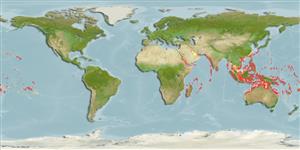
Indo-Pacific: Red Sea and East Africa (Ref. 33390) to the Marquesas and Oeno Atoll (Pitcairn Group), north to the Ryukyu and Hawaiian islands, south to New Caledonia and the Austral Islands.
Tamaño / Peso / Edad
Madurez: Lm ? range ? - ? cm
Max length : 300 cm TL macho / no sexado; (Ref. 9710); peso máximo publicado: 30.0 kg (Ref. 30404)
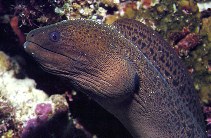
Espinas dorsales (total) : 0; Espinas anales: 0; Vértebra: 137 - 143. Juveniles are tan with numerous large black spots. Adults have black specks that grade into leopard-like spots behind the head and a black area surrounding the gill opening.
Body shape (shape guide): eel-like.
Found in lagoon and seaward reefs. Commonly seen species along deep drop-offs and slopes in Indonesian waters (Ref. 48635). Benthic (Ref. 58302). Juveniles more secretive and occur on intertidal reef flats (Ref. 37816). It feeds primarily on fishes and occasionally on crustaceans. This is the largest Indo-Pacific moray eel (Ref. 30404), perhaps reaching 3 m in length. Because of its position at the top of the reef's food chain it is often ciguatoxic. Attacks humans when provoked (Ref. 3132). Minimum depth reported taken from Ref. 10713. Solitary in reef holes (Ref 90102).
Ciclo vital y comportamiento de apareamiento
Madurez | Reproducción | Puesta | Huevos | Fecundidad | Larva
Observations on prespawning behavior include a pair entwined around one another lying on the bottom of the reef area (Ref. 93344).
Chen, H.-M., K.-T. Shao and C.T. Chen, 1994. A review of the muraenid eels (Family Muraenidae) from Taiwan with descriptions of twelve new records. Zool. Stud. 33(1):44-64. (Ref. 6934)
Situación en la Lista Roja de la UICN (Ref. 130435: Version 2025-2 (Global))
Amenaza para el ser humano
Reports of ciguatera poisoning (Ref. 4690)
Usos humanos
Pesquerías: pesquerías de subsistencia; Acuario: Acuarios públicos
Herramientas
Informes especiales
Descargar XML
Fuentes de Internet
Estimaciones basadas en modelos
Temperatura preferida (Referencia
123201): 25.5 - 29, mean 28.1 °C (based on 902 cells).
Índice de diversidad filogenética (Referencia
82804): PD
50 = 0.5000 [Uniqueness, from 0.5 = low to 2.0 = high].
Bayesian length-weight: a=0.00052 (0.00033 - 0.00084), b=3.28 (3.15 - 3.41), in cm total length, based on LWR estimates for this species & Genus-body shape (Ref.
93245).
Nivel trófico (Referencia
69278): 3.9 ±0.64 se; based on food items.
Resiliencia (Referencia
120179): Alto, población duplicada en un tiempo mínimo inferior a 15 meses (Fec = 200,000-300,000).
Vulnerabilidad pesquera (Ref.
59153): Very high vulnerability (90 of 100).
🛈
Nutrientes (Ref.
124155): Calcium = 13.9 [6.4, 22.6] mg/100g; Iron = 0.337 [0.184, 0.805] mg/100g; Protein = 18.8 [16.5, 21.5] %; Omega3 = 0.0798 [, ] g/100g; Selenium = 66.2 [30.4, 144.6] μg/100g; VitaminA = 33.1 [8.1, 132.9] μg/100g; Zinc = 0.763 [0.513, 1.122] mg/100g (wet weight);