Élasmobranches (requins et raies) (sharks and rays) >
Rajiformes (Skates and rays) >
Rajidae (Skates)
Etymology: Neoraja: Greek, neos = new + Latin, raja = fish, Raja sp. (Ref. 45335); iberica: Named for its type locality, a very restricted area of the eastern North Atlantic along SW slope of the Iberian Peninsula, in both the Portuguese and Spanish sectors.
Environnement : milieu / zone climatique / profondeur / gamme de distribution
Écologie
marin bathydémersal; profondeur 270 - 784 m (Ref. 106604). Subtropical
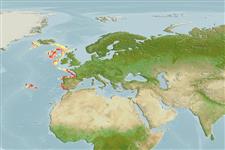
Northeastern Atlantic: Iberian Peninsula, Spain and Portugal.
Longueur à la première maturité / Taille / Poids / Âge
Maturité: Lm 28.5, range 28 - 29 cm
Max length : 35.0 cm TL mâle / non sexé; (Ref. 106604); 31.6 cm TL (female)
Description synthétique
Clés d'identification | Morphologie | Morphométrie
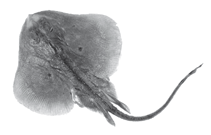
This species is distinguished by the following characteristics: ochre to greyish brown or dark greyish disc and posterior pelvic lobes distinctly ornamented dorsally by many dark brown spots and dots and usually a few paired whitish spots in small and half-grown specimens, all often reduced in larger specimens to few pairs if larger symmetrically placed brown, pale edged spots, plus 1-2 pairs of pale spots or dots; disc inverse heart-shaped with snout tip with short, triangular projections; length of tail about 62% (mean) of TL; lateral folds only along the posterior half or 1/3 of tail length; hypocordal lobe on caudal fin; anterior pelvic lobes about 3/4 of posterior lobe length; no nasobasal fenestrae on cranium, with narrow anterior fontanelle and delicate, thin rostral shaft almost reaching rostral node (Ref. 75590).
Body shape (shape guide): other.
Cycle de vie et comportement reproducteur
Maturité | Reproduction | Frai | Œufs | Fécondité | Larves
Stehmann, M.F.W., B. Séret, E.M. Costa and J. Baro, 2008. Neoraja iberica n. sp., a new species of pygmy skate (Elasmobranchii, Rajidae) from the southern slope of the Iberian Peninsula (Eastern North Atlantic). Cybium 32(1):51-71. (Ref. 75590)
Statut dans la liste rouge de l'IUCN (Ref. 130435: Version 2025-2 (Global))
Menace pour l'homme
Harmless
Utilisations par l'homme
Outils
Articles particuliers
Télécharger en XML
Sources Internet
Estimations basées sur des modèles
Température préférée (Réf.
123201): 6.6 - 11.2, mean 9.9 °C (based on 24 cells).
Indice de diversité phylogénétique (Réf.
82804): PD
50 = 0.5312 [Uniqueness, from 0.5 = low to 2.0 = high].
Bayesian length-weight: a=0.00302 (0.00141 - 0.00645), b=3.24 (3.07 - 3.41), in cm total length, based on LWR estimates for this (Sub)family-body shape (Ref.
93245).
Niveau trophique (Réf.
69278): 3.6 ±0.6 se; based on size and trophs of closest relatives
Résilience (Réf.
120179): Faible, temps minimum de doublement de population : 4,5 à 14 années (Preliminary low fecundity).
Vulnérabilité de la pêche (Ref.
59153): Low vulnerability (25 of 100).
🛈
Nutriments (Ref.
124155): Calcium = 22.2 [2.8, 390.2] mg/100g; Iron = 0.852 [0.081, 10.093] mg/100g; Protein = 16.3 [14.2, 18.3] %; Omega3 = 0.566 [0.237, 1.407] g/100g; Selenium = 28 [5, 143] μg/100g; VitaminA = 7.76 [0.62, 86.44] μg/100g; Zinc = 0.557 [0.036, 6.585] mg/100g (wet weight);