Klassifizierung / Names
Namen | Synonyme | Catalog of Fishes(Gattung, Arten) | ITIS | CoL | WoRMS | Cloffa
>
Characiformes (Characins) >
Characidae (Characins; tetras) > Cheirodontinae
Etymology: Odontostilbe: Greek, odous = teeth + Greek, stilbe, es = lamp (Ref. 45335); splendida: From the Latin word splendidus, meaning splendid, grand, admirable.
Umwelt: Milieu / Klimazone / Tiefenbereich / Verbreitungsgebiet
Ökologie
; süßwasser benthopelagisch; tiefenbereich 1 - ? m (Ref. 75063). Tropical
South America: Rio Orinoco basin.
Größe / Gewicht / Alter
Geschlechtsreife: Lm ? range ? - ? cm
Max length : 3.6 cm SL Männchen/unbestimmt; (Ref. 75063); 4.2 cm SL (female)
Kurzbeschreibung
Bestimmungsschlüssel | Morphologie | Morphometrie
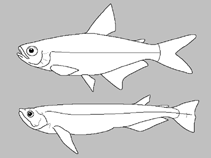
Rückenflossenweichstrahlen (insgesamt) : 11. Distinguished readily from all congeners including the sympatric Odontostilbe pulchra and Odontostilbe pao by its anterior position of the adipose fin, at vertical through last 2nd or 3rd anal-fin ray insertions. Can be further differentiated from Odontostilbe pulchra by a group of morphometric characters in males: snout pointed and longer 24.1-26.9% HL (vs. short and blunt in Odontostilbe pulchra, 18.0-26.0% HL); shorter pectoral-fin length 20.9-23.5% SL (vs. 21.3-26.4% SL); smaller anal-fin base 24.9-26.8% SL (vs. 26.0-31.4% SL); shorter caudal peduncle length 11.5- 13.0% SL (vs. 12.5-16.0% SL) ; longer snout-pelvic fin origin distance 45.1-48.7% SL (vs. 42.3-47.9% SL); and longer snout-anal fin origin distance 63.7-68.6% SL (vs. 58.6-64.0% SL). Furthermore, mature males have hooks on 1st to 6th-7th anal-fin rays (vs. hooks on 1st to 22nd anal-fin branched rays in Odontostilbe pulchra). Mature males usually have the 2nd unbranched dorsal-fin ray elongate, not present in Odontostilbe pulchra. Females and immature specimens, and not well-developed males can be differentiated from Odontostilbe pulchra by the following features: maxillary teeth 3-4, mostly 3 (vs. 2-3, mostly 2 in Odontostilbe pulchra; lateral line with 36 scales, one specimen 35 (vs. 33-37, mostly 34-35). Differs also from Odontostilbe fugitiva by its gill rakers counts on lower branch, averaging 11 (vs. usually 12) (Ref. 75063).
Body shape (shape guide): elongated; Cross section: compressed.
Found in muddy and sandy bottom and water depth nearly 1 m (Ref. 75063).
Lebenszyklus und Paarungsverhalten
Geschlechtsreife | Fortpflanzung | Ablaichen | Eier | Fruchtbarkeit | Larven
Bührnheim, C.M. and L.R. Malabarba, 2007. Redescription of Odontostilbe pulchra (Gill, 1858) (Teleostei: Characidae: Cheirodontinae), and description of two new species from the río Orinoco basin. Neotrop. Ichthyol. 5(1):1-20. (Ref. 75063)
IUCN Rote Liste Status (Ref. 130435: Version 2025-2 (Global))
Bedrohung für Menschen
Harmless
Nutzung durch Menschen
Tools
Zusatzinformationen
Download XML
Internet Quellen
Schätzungen auf der Grundlage von Modellen
Phylogenetischer Diversitätsindex (Ref.
82804): PD
50 = 0.5000 [Uniqueness, from 0.5 = low to 2.0 = high].
Bayesian length-weight: a=0.00912 (0.00403 - 0.02064), b=3.06 (2.87 - 3.25), in cm total length, based on LWR estimates for this (Sub)family-body shape (Ref.
93245).
Trophische Ebene (Ref.
69278): 2.5 ±0.5 se; based on size and trophs of closest relatives
Anfälligkeit der Fischerei (Ref.
59153): Low vulnerability (10 of 100).
🛈