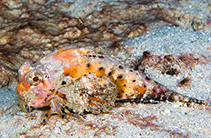
Environnement : milieu / zone climatique / profondeur / gamme de distribution
Écologie
marin démersal; profondeur 40 - ? m (Ref. 90102). Tropical
Indo-West Pacific: Red Sea and the Persian Gulf, eastwards to Pakistan, India, Gulf of Thailand, China and the Philippines. Reported as likely at Seychelles (Ref. 1623) but Randall and van Egmond 1994 (Ref. 10685) believe otherwise.
Taille / Poids / Âge
Maturité: Lm ? range ? - ? cm
Max length : 14.0 cm TL mâle / non sexé; (Ref. 121532); common length : 10.0 cm TL mâle / non sexé; (Ref. 3503); poids max. publié: 64.00 g (Ref. 121532)
Épines dorsales (Total) : 12 - 14; Rayons mous dorsaux (Total) : 8 - 9; Épines anales: 2; Rayons mous anaux: 8 - 9.
Body shape (shape guide): short and / or deep; Cross section: oval.
Inhabits sand or mud bottoms. Sold in small quantities either fresh or dried salted in markets.
Cycle de vie et comportement reproducteur
Maturité | Reproduction | Frai | Œufs | Fécondité | Larves
Poss, S.G. and K.V. Rama Rao, 1984. Scorpaenidae. In W. Fischer and G. Bianchi (eds.) FAO species identification sheets for fishery purposes. Western Indian Ocean (Fishing Area 51). Vol. 4. FAO, Rome. pag. var. (Ref. 3503)
Statut dans la liste rouge de l'IUCN (Ref. 130435: Version 2025-2 (Global))
Utilisations par l'homme
Pêcheries: intérêt commercial mineur
Outils
Articles particuliers
Télécharger en XML
Sources Internet
Estimations basées sur des modèles
Indice de diversité phylogénétique (Réf.
82804): PD
50 = 0.5625 [Uniqueness, from 0.5 = low to 2.0 = high].
Bayesian length-weight: a=0.02399 (0.01186 - 0.04850), b=2.89 (2.70 - 3.08), in cm total length, based on LWR estimates for this species & (Sub)family-body (Ref.
93245).
Niveau trophique (Réf.
69278): 3.8 ±0.7 se; based on size and trophs of closest relatives
Résilience (Réf.
120179): Haut, temps minimum de doublement de population inférieur à 15 mois (Preliminary K or Fecundity.).
Vulnérabilité de la pêche (Ref.
59153): Low vulnerability (10 of 100).
🛈