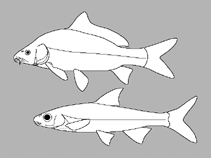
Classification / Noms
Noms communs | Synonymes | Catalog of Fishes(Genre, Espèce) | ITIS | CoL | WoRMS | Cloffa
>
Cypriniformes (Carps) >
Cyprinidae (Minnows or carps) > Smiliogastrinae
Etymology: Pethia: Pethia is the generic vernacular name for small cyprinids in Sinhala; nankyweensis: Named for the stream in which the type locality is situated, the Nan Kywe Chaung near Myitkyina.
More on author: Kullander.
Environnement : milieu / zone climatique / profondeur / gamme de distribution
Écologie
; eau douce démersal. Tropical
Asia: small streams near Myitkyina, Myanmar.
Taille / Poids / Âge
Maturité: Lm ? range ? - ? cm
Max length : 3.3 cm SL mâle / non sexé; (Ref. 75627)
Description synthétique
Clés d'identification | Morphologie | Morphométrie
Rayons mous dorsaux (Total) : 11 - 12; Rayons mous anaux: 8. Belongs to the Puntius conchonius species group, distinguished from other members
of that group by having lateral line scale row running straight from head to caudal fin base instead of curved, and first branched dorsal fin ray more than twice as long as last branched dorsal fin ray. This is similar to syntopic species Puntius erythromycter in possession of dark band encircling caudal peduncle well posterior to base of anal fin, absence of
humeral mark, and possession of 10 (rarely 11) circumpeduncular scales. Differs from Puntius erythromycter by presence of short maxillary barbels (vs. absence), transverse scale count ½ 3/1/4½ (vs. ½ 4/1/3½ ), scales in lateral row 20-23 (vs. 18-20), lateral scale row running straight (vs. curved) from head to caudal fin, caudal peduncle blotch positioned on scales 18-20 or 19-20 (vs. 16-17, 16-18), last branched dorsal fin ray less than half length of first (vs. more than half length of first), and very short anal fin (12.1-16.4 vs. 17.1-22.0 % of SL). Can be differentiated from Puntius yuensis and Puntius ornatus, also with dark band around caudal peduncle, by presence of maxillary barbels (vs. absence), transverse scale count ½ 3/1/4½ (vs. ½ 4/1/3½ ), last branched dorsal fin ray less than half length of first (vs. more than half length of first), and lateral scale row running straight horizontal (vs. curved) (Ref. 75627).
Body shape (shape guide): short and / or deep.
Cycle de vie et comportement reproducteur
Maturité | Reproduction | Frai | Œufs | Fécondité | Larves
Kullander, S.O., 2008. Five new species of Puntius from Myanmar (Teleostei: Cyprinidae). Ichthyol. Explor. Freshwat. 19(1):59-84. (Ref. 75627)
Statut dans la liste rouge de l'IUCN (Ref. 130435: Version 2025-2 (Global))
Menace pour l'homme
Harmless
Utilisations par l'homme
Outils
Articles particuliers
Télécharger en XML
Sources Internet
Estimations basées sur des modèles
Indice de diversité phylogénétique (Réf.
82804): PD
50 = 0.5000 [Uniqueness, from 0.5 = low to 2.0 = high].
Bayesian length-weight: a=0.01622 (0.00606 - 0.04338), b=2.94 (2.71 - 3.17), in cm total length, based on LWR estimates for this (Sub)family-body shape (Ref.
93245).
Niveau trophique (Réf.
69278): 2.8 ±0.2 se; based on size and trophs of closest relatives
Résilience (Réf.
120179): Haut, temps minimum de doublement de population inférieur à 15 mois (Preliminary K or Fecundity.).
Vulnérabilité de la pêche (Ref.
59153): Low vulnerability (10 of 100).
🛈