分类 / 名称
俗名 | 同种异名 | Catalog of Fishes(属, 种) | ITIS | CoL | WoRMS | Cloffa
Teleostei >
Gobiiformes (Gobies) >
Xenisthmidae (Collared wrigglers)
Etymology: Xenisthmus: Greek, xenos = strange + Greek, isthmos = throat, narrow passage (Ref. 45335); eirospilus: Name from the Greek 'eiro' meaning to join in lines or string together, and 'spilos' for spot or fleck, refers to the prominent pattern of closely spaced dark spots on the mid-side; noun in apposition.
More on authors: Gill & Hoese.
环境:氛围 / 气候带 / 深度上下限 / 分布范围
生态学
海洋 居于水底的; 深度上下限 0 - 35 m (Ref. 59014), usually 0 - 10 m (Ref. 90102).
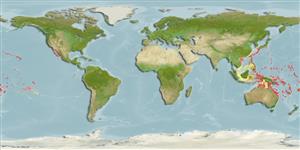
Southwestern Pacific: Tasman Sea and the Solomons.
大小 / 重量 / 年龄
成熟度: Lm ? range ? - ? cm
Max length : 1.8 cm SL 雄鱼/尚未辨别雌雄; (Ref. 59014); 2.1 cm SL (female)
简单描述
检索表 | 型态特徵 | 形态测量图
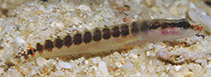
背棘 (总数) : 7; 背的软条 (总数) : 12 - 13; 臀棘: 1; 臀鳍软条: 11 - 12; 脊椎骨: 27. This species is characterized by the following: second dorsal-fin rays I, 12-13 (usually I, 12); A I, 11-12 (usually I, 11); vertebrae 10 + 17; indented tongue; posterior naris with well-developed flap on anterior rim; upper sides of the body with 12 large, closely spaced spots, these usually do not extend to dorsal edge of body; predorsal area broadly scaled to about vertical through posterior edge of preopercle (Ref. 59014).
Body shape (shape guide): elongated.
A benthic, inshore species found in coral reefs (Ref. 75154). Also found in sand patches among reefs and rubble, often in surge areas (Ref 90102).
生命周期和交配行为
成熟度 | 繁殖 | 产卵场 | 卵 | 孕卵数 | 仔鱼
Gill, A.C. and D.F. Hoese, 2004. Three new Australian species of the fish genus Xenisthmus (Gobioidei: Xenisthmidae). Rec. Aust. Mus.56(2):241-246. (Ref. 59014)
世界自然保护联盟红皮书 (Ref. 130435: Version 2025-2 (Global))
人类利用
工具
特别资料
下载 XML
网络资源
基于模型的估算
首选温度 (参考文献
123201): 23.5 - 29.3, mean 28.2 °C (based on 1855 cells).
系统发育多样性指数 (参考文献
82804): PD
50 = 0.5010 [Uniqueness, from 0.5 = low to 2.0 = high].
Bayesian length-weight: a=0.00389 (0.00180 - 0.00842), b=3.12 (2.94 - 3.30), in cm total length, based on all LWR estimates for this body shape (Ref.
93245).
营养阶层 (参考文献
69278): 3.1 ±0.4 se; based on size and trophs of closest relatives
渔业脆弱性 (Ref.
59153): Low vulnerability (10 of 100).
🛈