>
Eupercaria/misc (Various families in series Eupercaria) >
Labridae (Wrasses) > Cirrhilabrinae
Etymology: Cirrhilabrus: Latin, cirrus = curl fringe + Greek, labros = furious (Ref. 45335); cenderawasih: Named for its type locality, Cenderawasih Bay; noun in apposition.
Milieu: milieu / Klimaatzone / Diepte / verspreidingsgebied
Ecologie
marien rifbewoner; diepte 22 - 60 m (Ref. 75881). Tropical
Western Pacific: Indonesia.
Grootte / Gewicht / Leeftijd
Maturiteit: Lm ? range ? - ? cm
Max length : 6.5 cm SL mannelijk / geslacht onbekend; (Ref. 75881); 4.7 cm SL (female)
Korte beschrijving
Determinatiesleutels | Morfologie | Morfometrie
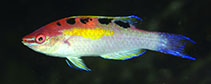
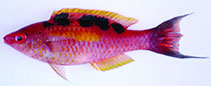
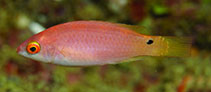
Dorsale stekels (totaal) : 11; Dorsale zachte stralen (totaal) : 9; Anale stekels: 3; Anale zachte stralen: 9. This species is distinguished by the following characters: D XI, 9; A III, 9; pectoral rays 15; lateral-line scales 14-16 + 6-9; median predorsal scales 5; horizontal scale rows on cheek below eye 2; gill rakers 14-17; body depth 2.9-3.2 in SL; head length 2.9-3.2 in SL; snout length 3.8-4.7 in head; males' caudal fin strongly lunate with produced lobes; pelvic fins relatively short, not reaching anal fin origin when depressed; live colour pattern features of males include a pink overall coloration with broad, irregular yellow stripe or rectangular blotch on middle of side, and series of 4-5 large, irregular black blotches along back, extending on to adjacent basal portion of dorsal fin; female mainly reddish pink with pupil sized black spot on upper caudal peduncle (Ref. 75881).
Body shape (shape guide): fusiform / normal.
This species is common on sheltered seaward reefs, primarily on the inner and eastern portions of the Cenderawasih Bay at depths between about 22 to 60 m, although it is more abundant below about 35 m. Observed to be in groups of about 10 to 20 individuals, including one to five males, and were typically encountered on rubble slopes or on rubble substrates at the base of slopes. Apparently feeds on zooplankton, which is typical for the genus, at a short distance above the bottom (Ref. 75881).
Levenscyclus en paargedrag
Maturiteit | Voortplanting | Paaien | Eieren | Fecunditeit | Larven
Distinct pairing during breeding (Ref. 205).
Allen, G.R. and M.V. Erdmann, 2006. Cirrhilabrus cenderawasih, a new wrasse (Pisces: Labridae) from Papua, Indonesia. aqua, J. Ichthyol. Aquat. Biol. 11(3):125-131. (Ref. 75881)
Status op de Rode Lijst van het IUCN (Ref. 130435: Version 2025-2 (Global))
Gevaar voor de mens
Harmless
Gebruik door de mens
Tools
Speciale rapporten
Download XML
Internetbronnen
Schattingen op basis van modellen
Gewenste temperatuur (Ref.
123201): 27.2 - 28.5, mean 28.1 °C (based on 15 cells).
Fylogenetische diversiteitsindex (Ref.
82804): PD
50 = 0.5000 [Uniqueness, from 0.5 = low to 2.0 = high].
Bayesian length-weight: a=0.01072 (0.00427 - 0.02691), b=3.03 (2.81 - 3.25), in cm total length, based on LWR estimates for this (Sub)family-body shape (Ref.
93245).
Trofisch niveau (Ref.
69278): 3.3 ±0.4 se; based on size and trophs of closest relatives
Weerstandsvermogen (Ref.
120179): Hoog, minimale populatieverdubbelingstijd minder dan 15 maanden (Preliminary K or Fecundity.).
Kwetsbaarheid van de visserij (Ref.
59153): Low vulnerability (10 of 100).
🛈