>
Gobiiformes (Gobies) >
Gobiidae (Gobies) > Gobiinae
Etymology: attenuata: Name from Latin word meaning 'drawn out' or 'tapering', refers to the prolonged tapering filament formed by the middle five caudal rays.
Eponymy: Professor Cornelius Jan van der Horst (1889–1951) was a Dutch zoologist who moved to South Africa (1928) and became Head of the Zoology Department, Witwatersrand University, Johannesburg. [...] (Ref. 128868), visit book page.
More on author: Randall.
Milieu: milieu / Klimaatzone / Diepte / verspreidingsgebied
Ecologie
marien benthopelagisch; diepte 15 - 48 m (Ref. 90102). Tropical
Western Central Pacific: Solomon Is.
Grootte / Gewicht / Leeftijd
Maturiteit: Lm ? range ? - ? cm
Max length : 3.6 cm SL mannelijk / geslacht onbekend; (Ref. 75899)
Korte beschrijving
Determinatiesleutels | Morfologie | Morfometrie
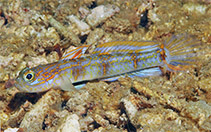
Dorsale stekels (totaal) : 7; Dorsale zachte stralen (totaal) : 11; Anale stekels: 1; Anale zachte stralen: 11. This species is diagnosed by the following characters: D VI-I, 11; A I, 11; pectoral rays 19; scales in longitudinal series 39; median predorsal scales 15; scales on head absent except dorsally behind eye; scales on prepectoral area; body not very elongate, depth 5.35 in SL; orbit diameter 3.2 in HL; third dorsal spine longest, 3.95 in SL; caudal fin long, the middle five rays prolonged into a tapering filament as long as rest of fin, total fin length 2.15 in SL; pectoral fins reaching to above origin of anal fin, 3.6 in SL; pelvic fins just reaching anus, 4.9 in SL (Ref. 75899); characterized further by pale bluish grey body color with four diffuse brown bars on body; nape and body with orange lines and small spots; lower half of side has a zone of elongate orange spots and occasional vertical orange lines; cheek and operculum with dark-edged orange bands and spots; dorsal fins bluish with dusky orange bands; united pelvic fins, presence of well developed frenum; cycloid scales covering body anteriorly, ctenoid posteriorly (Ref. 90102).
Body shape (shape guide): elongated; Cross section: compressed.
Inhabit sand-rubble or mud bottoms in 15-48 m (Ref 90102).
Levenscyclus en paargedrag
Maturiteit | Voortplanting | Paaien | Eieren | Fecunditeit | Larven
Randall, J.E., 2007. Descriptions of four new shrimpgobies of the genus Vanderhorstia from the Western Pacific. aqua, Int. J. Ichthyol. 12(3):89-100. (Ref. 75899)
Status op de Rode Lijst van het IUCN (Ref. 130435: Version 2025-2 (Global))
Gevaar voor de mens
Harmless
Gebruik door de mens
Tools
Speciale rapporten
Download XML
Internetbronnen
Schattingen op basis van modellen
Gewenste temperatuur (Ref.
123201): 27.9 - 29.1, mean 28.5 °C (based on 24 cells).
Fylogenetische diversiteitsindex (Ref.
82804): PD
50 = 0.5000 [Uniqueness, from 0.5 = low to 2.0 = high].
Bayesian length-weight: a=0.00741 (0.00347 - 0.01582), b=3.09 (2.91 - 3.27), in cm total length, based on LWR estimates for this (Sub)family-body shape (Ref.
93245).
Trofisch niveau (Ref.
69278): 3.2 ±0.3 se; based on size and trophs of closest relatives
Weerstandsvermogen (Ref.
120179): Hoog, minimale populatieverdubbelingstijd minder dan 15 maanden (Preliminary K or Fecundity.).
Kwetsbaarheid van de visserij (Ref.
59153): Low vulnerability (10 of 100).
🛈