>
Siluriformes (Catfishes) >
Loricariidae (Armored catfishes) > Hypostominae
Etymology: Pterygoplichthys: Greek, pterygion, diminutive of pteryx = wing, fin + Greek, hoplon = weapon + Greek, ichthys = fish (Ref. 45335); weberi: Named after Claude Weber of the Muséum d'histoire naturelle , Geneva, for his fine work on Pterygoplichthys and his contributions to loricariid systematics.
Eponymy: Dr Claude Weber works at the Department of Herpetology and Ichthyology, Muséum d’Histoire Naturelle de Génève. [...] (Ref. 128868), visit book page.
Môi trường: môi trường / vùng khí hậu / Mức độ sâu / phạm vi phân phối
Sinh thái học
; nước ngọt gần đáy. Tropical
South America: Rio Marañon, Rio Ucayali, Rio Caquetá and upper Rio Amazonas drainages of Colombia, Ecuador and Peru.
Bộ gần gũi / Khối lượng (Trọng lượng) / Tuổi
Chín muồi sinh dục: Lm ? range ? - ? cm
Max length : 19.7 cm SL con đực/không giới tính; (Ref. 75871)
Mô tả ngắn gọn
Khóa để định loại | Hình thái học | Sinh trắc học
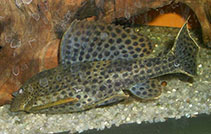
Các tia vây lưng cứng (tổng cộng) : 1; Các vây lưng mềm (tổng cộng) : 11 - 12; Tia cứng vây hậu môn: 1; Tia mềm vây hậu môn: 4. Distinguished from all congeners except Pterygoplichthys punctatus by having the buccal papilla at least shallowly divided medially; and by having the lateral keel odontodes almost perpendicular to the plates (vs. sloped posteriorly) and by having the longest keel odontodes longer than the plates in the lateral-line row in the adult. Differs further Pterygoplichthys punctatus by having the buccal papilla partially divided in the adult (vs. fully divided at all ages), by having few spots on the abdomen and the bases of the fins (vs. many spots), and by having a wider body (SL/cleithral width 3.3-3.4 vs. 3.6-4.0). Can be further distinguished from Pterygoplichthys scrophus, Pterygoplichthys gibbiceps, Pterygoplichthys joselimaianus, Pterygoplichthys xinguensis, Pterygoplichthys lituratus, and Pterygoplichthys parnaibae by the absence of an elevated supraoccipital (vs. presence of an elevated supraoccipital forming an obvious crest); from Pterygoplichthys etentaculatus by having fewer than five hypertrophied odontodes on the cheek plates (vs. more than five); from Pterygoplichthys joselimaianus by having dark spots (vs. light spots); from Pterygoplichthys undecimalis and Pterygoplichthys zuliaensis by having a broadly round snout (vs. a narrow pointed snout); from Pterygoplichthys multiradiatus by usually having 11 dorsal-fin rays (occasionally 12 vs. 12-13); and from Pterygoplichthys anisitsi,
Pterygoplichthys disjunctivus, Pterygoplichthys multiradiatus, and Pterygoplichthys pardalis by having hypertrophied odontodes on the cheek plates of the adult (vs. hypertrophied cheek odontodes absent) (Ref. 75871).
Body shape (shape guide): elongated.
Facultative air-breathing (Ref. 126274)
Vòng đời và hành vi giao phối
Chín muồi sinh dục | Sự tái sinh sản | Đẻ trứng | Các trứng | Sự sinh sản | Ấu trùng
Armbruster, J.W. and L.M. Page, 2006. Redescription of Pterygoplichthys punctatus and description of a new species of Pterygoplichthys (Siluriformes: Loricariidae). Neotrop. Ichthyol. 4(4):401-409. (Ref. 75871)
Tình trạng Sách đỏ IUCN (Ref. 130435: Version 2025-2 (Global))
Mối đe dọa đối với con người
Harmless
Sử dụng của con người
Các công cụ
Báo cáo đặc biệt
Tải xuống XML
Các nguồn internet
Ước tính dựa trên mô hình
Chỉ số đa dạng phát sinh loài (Tài liệu tham khảo
82804): PD
50 = 0.5000 [Uniqueness, from 0.5 = low to 2.0 = high].
Bayesian length-weight: a=0.01995 (0.00870 - 0.04578), b=2.95 (2.78 - 3.12), in cm total length, based on LWR estimates for this Genus-body shape (Ref.
93245).
Thích nghi nhanh (Tài liệu tham khảo
120179): Trung bình, thời gian nhân đôi của chủng quần tối thiểu là 1.4 - 4.4 năm (Preliminary K or Fecundity.).
Sự dễ bị tổn thương của nghề đánh cá (Ref.
59153): Low vulnerability (14 of 100).
🛈