Classification / Noms
Noms communs | Synonymes | Catalog of Fishes(Genre, Espèce) | ITIS | CoL | WoRMS | Cloffa
>
Perciformes/Uranoscopoidei (Sand dwellers) >
Pinguipedidae (Sandperches)
Etymology: Parapercis: Greek, para = the side of + Greek, perke = perch (Ref. 45335); banoni: Named for Rafael Bañón, who provided the authors with specimens and color photographs.
Eponymy: Rafael Bañón Díaz (d: 1961) is a Spanish research scientist and fisheries ecologist focusing on research on fish taxonomy, small scale fisheries, fishers and fisheries anthropology. [...] (Ref. 128868), visit book page.
More on authors: Randall & Yamakawa.
Environnement : milieu / zone climatique / profondeur / gamme de distribution
Écologie
marin bathydémersal; profondeur 220 - 235 m (Ref. 75889). Temperate
Distribution
Territoires | Zones FAO | Écosystèmes | Occurrences | Carte par point | Introductions | Faunafri
Southeastern Atlantic: Valdivia Bank. High Seas only.
Taille / Poids / Âge
Maturité: Lm ? range ? - ? cm
Max length : 19.2 cm SL mâle / non sexé; (Ref. 75889)
Description synthétique
Clés d'identification | Morphologie | Morphométrie
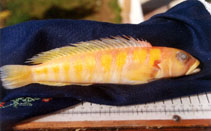
Épines dorsales (Total) : 5; Rayons mous dorsaux (Total) : 23 - 24; Épines anales: 0; Rayons mous anaux: 19; Vertèbres: 32. This species is characterized by the following: D V, 23-24; A I, 19; pectoral rays 20-21; lateral-line scales 61-63; gill rakers 3-6 + 10 or 11; canine teeth 3 pairs anteriorly in lower jaw; palatine teeth present; body depth 4.9-5.1 in SL; head length 3.6-3.7 in SL; last two dorsal spines longest and subequal; last interspinous membrane of dorsal fin attached to the first dorsal soft ray nearly 1/2 length of ray from base; caudal fin slightly rounded; pelvic fins not reaching anus, 1.55-1.65 in HL; orangish pink dorsally, shading to white below, upper side with 5 pairs of yellow bars, narrowing ventrally and becoming diffuse dorsally; a red spot above base of pectoral fin; spinous portion of dorsal fin no dark pigment (Ref. 75889).
Body shape (shape guide): elongated; Cross section: oval.
Cycle de vie et comportement reproducteur
Maturité | Reproduction | Frai | Œufs | Fécondité | Larves
Randall, J.E. and T. Yamakawa, 2006. Parapercis phenax from Japan and P. banoni from the Southeast Atlantic, new species of Pinguipedid fishes previously identified as P. roseoviridis. Zool. Stud. 45(1):1-10. (Ref. 75889)
Statut dans la liste rouge de l'IUCN (Ref. 130435: Version 2025-2 (Global))
Menace pour l'homme
Harmless
Utilisations par l'homme
Outils
Articles particuliers
Télécharger en XML
Sources Internet
Estimations basées sur des modèles
Indice de diversité phylogénétique (Réf.
82804): PD
50 = 0.5000 [Uniqueness, from 0.5 = low to 2.0 = high].
Bayesian length-weight: a=0.00692 (0.00314 - 0.01524), b=3.06 (2.88 - 3.24), in cm total length, based on LWR estimates for this Genus-body shape (Ref.
93245).
Niveau trophique (Réf.
69278): 3.6 ±0.4 se; based on size and trophs of closest relatives
Résilience (Réf.
120179): Milieu, temps minimum de doublement de population : 1,4 à 4,4 années (Preliminary K or Fecundity.).
Vulnérabilité de la pêche (Ref.
59153): Low vulnerability (13 of 100).
🛈