Clasificación / Nombres
Nombres comunes | Sinónimos | Catalog of Fishes(Género, Especie) | ITIS | CoL | WoRMS | Cloffa
>
Siluriformes (Catfishes) >
Loricariidae (Armored catfishes) > Hypoptopomatinae
Etymology: Otocinclus: Greek, ous, oto = ear + Latin, cinclus = latticework; in allusion to the holes of the head in the ears (Ref. 45335); batmani: The specific name batmani is an allusion to the Bob Kane's hero Batman of the comic adventures, which had a bat shape for his symbol, referring to the single W- or bat-shaped vertical spot on the caudal fin.
Eponymy: Batman, who has a bat shape for a symbol, is a comic book super-hero who first appeared in Detective Comics (1939). The etymology refers to the single W or bat-shaped vertical spot on the caudal fin of this species. (Ref. 128868), visit book page.
Entorno: milieu / zona climática / rango de profundidad / gama de distribución
Ecología
; agua dulce demersal. Tropical
South America: small stream tributary to the Río Puré in Colombia, and two creeks emptying into the Río Amazonas near Iquitos, Peru, in the upper Amazin River basin.
Tamaño / Peso / Edad
Madurez: Lm ? range ? - ? cm
Max length : 3.7 cm SL macho / no sexado; (Ref. 75892)
Descripción breve
Claves de identificación | Morfología | Morfometría
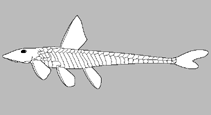
Espinas dorsales (total) : 2; Radios blandos dorsales (total) : 7 - 8; Radios blandos anales: 6; Vértebra: 22. Distinguished from all other congeners, except Otocinclus cocama, by having a single,
intensely pigmented, vertical W-shaped caudal fin spot and by having three discrete dark bands on dorsum, between the dorsal-fin base and the caudal fin. Can be separated from Otocinclus cocama by the absence of vertically elongated blotches from the dorsal midline to the ventral border of flanks, and by lacking the posterior extension of black
pigmentation on the base of two central caudal-fin rays. Differs from most Otocinclus
species, except Otocinclus bororo, Otocinclus cocama, Otocinclus mariae, Otocinclus mura, and Otocinclus huaorani, by possessing 20 or more teeth in both the premaxilla and dentary (vs. less that 20 in all other species) (Ref. 75892).
Body shape (shape guide): elongated.
Facultative air-breathing in the genus (Ref. 126274)
Ciclo vital y comportamiento de apareamiento
Madurez | Reproducción | Puesta | Huevos | Fecundidad | Larva
Lehmann A.P., 2006. Otocinclus batmani, a new species of hypoptopomatine catfish (Siluriformes: Loricariidae) from Colombia and Peru. Neotrop. Ichthyol. 4(4):379-383. (Ref. 75892)
Situación en la Lista Roja de la UICN (Ref. 130435: Version 2025-2 (Global))
Amenaza para el ser humano
Harmless
Usos humanos
Herramientas
Informes especiales
Descargar XML
Fuentes de Internet
Estimaciones basadas en modelos
Índice de diversidad filogenética (Referencia
82804): PD
50 = 0.5000 [Uniqueness, from 0.5 = low to 2.0 = high].
Bayesian length-weight: a=0.00977 (0.00434 - 0.02202), b=3.06 (2.87 - 3.25), in cm total length, based on LWR estimates for this (Sub)family-body shape (Ref.
93245).
Vulnerabilidad pesquera (Ref.
59153): Low vulnerability (10 of 100).
🛈