>
Perciformes/Scorpaenoidei (Scorpionfishes) >
Scorpaenidae (Scorpionfishes or rockfishes) > Scorpaeninae
Etymology: Scorpaena: Latin, scorpaena = a kind of fish, 1706 (Ref. 45335); pepo: Name from Latin 'pepo' for pumpkin, refers to the yellowish-orange body color of this species when fresh.
Milieu: milieu / Klimaatzone / Diepte / verspreidingsgebied
Ecologie
marien demersaal; diepte ? - 200 m (Ref. 75791). Subtropical
Northwest Pacific: Taiwan.
Grootte / Gewicht / Leeftijd
Maturiteit: Lm ? range ? - ? cm
Max length : 24.5 cm SL mannelijk / geslacht onbekend; (Ref. 75791)
Korte beschrijving
Determinatiesleutels | Morfologie | Morfometrie
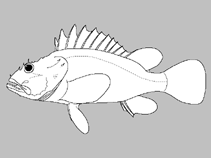
Dorsale stekels (totaal) : 12; Dorsale zachte stralen (totaal) : 9; Anale stekels: 3; Anale zachte stralen: 5; Wervels: 24. This species has the following combination of characters: 16 pectoral-fin rays; 46-48 longitudinal scales series; embedded cycloid scales covering anteroventral surface of body and pectoral-fin base; lateral line sloping steeply downward above anterior 1/2 of pectoral fin; posterior margin of maxilla extending well beyond a vertical through posterior margin of orbit; well developed median interorbital ridge, its highest portion greater in height than interorbital ridges; a single spine on the lateral surface of lacrimal; anterior lacrimal spine with an
additional spine; posterior lacrimal spine simple; suborbital spines 3, posterior end of 1st suborbital spine base below eye between posterior margins of pupil and orbit; space between upper and lower opercular spines not covered with fleshy skin; supraocular tentacle shorter than pupil diameter,1.7-3.9% (mean 3.1%) of SL in length; no tentacles on the underside of lower jaw; no skin flap on pectoral-fin axil; relatively deep body (depth 36.4-42.6% of SL); head and body when fresh yellowish-orange and with numerous small distinct black spots, averaging about 1/10 body scale diameter in size, scattered on entire head and body (except
for ventral surface of head and body), dorsal, anal and caudal fins, and upper 1/2 of pectoral fin; a large black blotch at the margin of membrane between 6th and 10th or 11th dorsal-fin spines in males (Ref. 75791).
Body shape (shape guide): fusiform / normal.
Levenscyclus en paargedrag
Maturiteit | Voortplanting | Paaien | Eieren | Fecunditeit | Larven
Motomura, H., S.G. Poss and K.-T. Shao, 2007. Scorpaena pepo, a new species of scorpionfish (Scorpaeniformes: Scorpaenidae) from Northeastern Taiwan, with a review of S. Onaria Jordan and Snyder. Zool. Stud. 46(1):35-45. (Ref. 75791)
Status op de Rode Lijst van het IUCN (Ref. 130435: Version 2025-2 (Global))
Gevaar voor de mens
Harmless
Gebruik door de mens
Tools
Speciale rapporten
Download XML
Internetbronnen
Schattingen op basis van modellen
Fylogenetische diversiteitsindex (Ref.
82804): PD
50 = 0.5000 [Uniqueness, from 0.5 = low to 2.0 = high].
Bayesian length-weight: a=0.01349 (0.00638 - 0.02853), b=3.01 (2.84 - 3.18), in cm total length, based on LWR estimates for this Genus-body shape (Ref.
93245).
Trofisch niveau (Ref.
69278): 3.7 ±0.2 se; based on size and trophs of closest relatives
Weerstandsvermogen (Ref.
120179): Gemiddeld, minimale populatieverdubbelingstijd 1,4-4,4 jaar (Preliminary K or Fecundity.).
Kwetsbaarheid van de visserij (Ref.
59153): Low vulnerability (20 of 100).
🛈