>
Characiformes (Characins) >
Anostomidae (Headstanders)
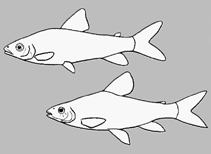
Etymology: Schizodon: Greek, schizein = to divide + Greek, odous = teeth (Ref. 45335); scotorhabdotus: Specific name derived from the Greek scotos (dark), and rhabdos (rod or stick), in reference to the prominent dark lateral stripe of this species,.
Entorno: milieu / zona climática / rango de profundidad / gama de distribución
Ecología
; agua dulce bentopelágico. Tropical
South America: Río Orinoco system in Venezuela and Colombia.
Longitud en la primera madurez / Tamaño / Peso / Edad
Madurez: Lm ?, range 28 - ? cm
Max length : 27.1 cm SL macho / no sexado; (Ref. 75767)
Descripción breve
Claves de identificación | Morfología | Morfometría
Radios blandos dorsales (total) : 11 - 12; Radios blandos anales: 9; Vértebra: 40 - 42. Can be separated from all congeners, except Schizodon isognathus, Schizodon knerii, and Schizodon nasutus, by the presence of a dark stripe running along the lateral-line-scale row from the rear of the opercle to the caudal peduncle (vs. absence of midlateral stripe in Schizodon altoparanae, Schizodon australis, Schizodon borelli, Schizodon corti, Schizodon dissimilis, Schizodon fasciatus, Schizodon intermedius, Schizodon platae, and Schizodon rostratus), and midlateral stripe extending no further anteriorly than to vertical drawn through dorsal-fin origin in Schizodon jacuiensis and Schizodon vittatus). Differs from Schizodon nasutus by a terminal or slightly upturned mouth (vs. a strongly subterminal mouth). Can be differentiated from Schizodon isognathus and Schizodon knerii by having 4 or 4.5 transverse scale rows above the lateral line to the dorsal-fin origin (vs. 6.5 scale rows [rarely 5.5 in Schizodon knerii]), 4 or 4.5 transverse scale rows below the lateral line to the anal-fin origin (vs. 5.5 scale rows [rarely 4.5 in Schizodon knerii]) and seven branched anal-fin rays (vs. eight). Differs further from Schizodon isognathus by the presence of three or four vertical dark blotches on the lateral surfaces of the body intersecting the prominent lateral stripe (vs. vertical blotches absent) and a terminal mouth in adults (vs. a slightly subterminal mouth in adults); and Schizodon knerii by having only 16 circumpeduncular scales (vs. 18-20) (Ref. 75767).
Found in lagoons, pools, small caños and cattle pastures, all relatively lentic habitats (Ref. 75767). Herbivorous, preferring macrophytes (Ref. 75767). Distinct pairs breed on densely grown weedy places (Ref. 205).
Ciclo vital y comportamiento de apareamiento
Madurez | Reproducción | Puesta | Huevos | Fecundidad | Larva
Distinct pairs breed on densely grown weedy places (Ref. 205).
Sidlauskas, B.L., J.C. Garavello and J. Jellen, 2007. A new Schizodon (Characiformes: Anostomidae) from the Río Orinoco system, with a redescription of S. isognathus from the Río Paraguay System. Copeia 2007(3):711-725. (Ref. 75767)
Situación en la Lista Roja de la UICN (Ref. 130435: Version 2025-2 (Global))
Amenaza para el ser humano
Harmless
Usos humanos
Herramientas
Informes especiales
Descargar XML
Fuentes de Internet
Estimaciones basadas en modelos
Índice de diversidad filogenética (Referencia
82804): PD
50 = 0.5000 [Uniqueness, from 0.5 = low to 2.0 = high].
Bayesian length-weight: a=0.00776 (0.00349 - 0.01726), b=3.06 (2.88 - 3.24), in cm total length, based on LWR estimates for this Genus-body shape (Ref.
93245).
Nivel trófico (Referencia
69278): 2.5 ±0.2 se; based on size and trophs of closest relatives
Resiliencia (Referencia
120179): Medio, población duplicada en un tiempo mínimo de 1.4-4.4 años (Preliminary K or Fecundity.).
Vulnerabilidad pesquera (Ref.
59153): Low vulnerability (23 of 100).
🛈