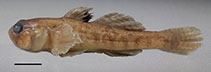
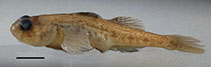
Classification / Noms
Noms communs | Synonymes | Catalog of Fishes(Genre, Espèce) | ITIS | CoL | WoRMS | Cloffa
>
Gobiiformes (Gobies) >
Gobiidae (Gobies) > Gobionellinae
Etymology: Knipowitschia: Because of N.M.Knipowitsch, a zoologist and Russian ichthyologist from the Academy of Sciences. Expeditions in "Pomor" and "Pervosvanniy" ships to Azov and Black sea (1898-1908); montenegrina: The specific epithet is derived from that of Montenegro, where the type material was collected.
Eponymy: Nikolai Mikhailovich Knipovich (also given as Knipowitsch) (1862–1939) was a Russian oceanographer, marine zoologist and ichthyologist. [...] (Ref. 128868), visit book page.
Environnement : milieu / zone climatique / profondeur / gamme de distribution
Écologie
; eau douce démersal. Temperate
Europe: River Morača, southern Montenegro.
Taille / Poids / Âge
Maturité: Lm ? range ? - ? cm
Max length : 2.8 cm SL mâle / non sexé; (Ref. 75974)
Description synthétique
Clés d'identification | Morphologie | Morphométrie
Épines dorsales (Total) : 7; Rayons mous dorsaux (Total) : 7 - 8; Épines anales: 1; Rayons mous anaux: 6 - 7. Distinguished from all congeners, except Knipowitschia croatica, Knipowitschia ephesi and Knipowitschia punctatissima, by the body squamation reduced to axillary patch and head canals absent. Can be differentiated from Knipowitschia punctatissima, Knipowitschia ephesi and Knipowitschia croatica by the following combination of characters: D1 VI; P extends back approximately to below posterior end of D1; pelvic disc with midline depth of anterior membrane 1/3-1/2 length of pelvic spinous ray; neuromast suborbital row a reaching anteriorly at maximum to below middle of eye; suborbital row b reaching anteriorly at maximum to below rear border of eye; single suborbital transverse row cp situated below beginning of row b; anterior dorsal row g shorter than distance between row g and n; and preorbital row s ending anteriorly in front of anterior end of row r p not clearly separated (Ref. 75974).
Body shape (shape guide): fusiform / normal.
Occurs in river shallows with slow current and in pools remaining in gravel pits after river flooding. The substrate consists of gravel, covered with fine sediment and overgrown by dense filamentous algae (Ref. 75974).
Cycle de vie et comportement reproducteur
Maturité | Reproduction | Frai | Œufs | Fécondité | Larves
Kovačić, M. and R. Sanda, 2007. A new species of Knipowitschia (Perciformes: Gobiidae) from southern Montenegro. J. Natl. Mus. (Prague), Nat. Hist. Ser. 176(5):81-89. (Ref. 75974)
Statut dans la liste rouge de l'IUCN (Ref. 130435: Version 2025-2 (Global))
Menace pour l'homme
Harmless
Utilisations par l'homme
Outils
Articles particuliers
Télécharger en XML
Sources Internet
Estimations basées sur des modèles
Indice de diversité phylogénétique (Réf.
82804): PD
50 = 0.5000 [Uniqueness, from 0.5 = low to 2.0 = high].
Bayesian length-weight: a=0.01023 (0.00452 - 0.02316), b=3.00 (2.81 - 3.19), in cm total length, based on LWR estimates for this (Sub)family-body shape (Ref.
93245).
Niveau trophique (Réf.
69278): 3.2 ±0.4 se; based on size and trophs of closest relatives
Résilience (Réf.
120179): Haut, temps minimum de doublement de population inférieur à 15 mois (Preliminary K or Fecundity.).
Vulnérabilité de la pêche (Ref.
59153): Low vulnerability (10 of 100).
🛈