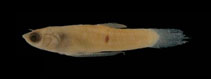
การจำแนกประเภท / ชื่อ
ชื่อสามัญ | ชื่อพ้อง | Catalog of Fishes(สกุล, ชนิด) | ITIS | CoL | WoRMS | Cloffa
>
Cyprinodontiformes (Rivulines, killifishes and live bearers) >
Poeciliidae (Poeciliids) > Poeciliinae
Etymology: Phalloceros: Greek, phallos = penis + Greek, keras = horn (Ref. 45335); malabarbai: The specific epithet malabarbai is a patronym for Luiz Roberto Malabarba, in recognition of his many contributions to Neotropical ichthyology.
Eponymy: Dr Luiz Roberto Malabarba is a Brazilian ichthyologist and biologist. [...] (Ref. 128868), visit book page.
สิ่งแวดล้อม : สิ่งแวดล้อม / เขตภูมิอากาศ / ระดับความลึก / ระยะการกระจายสินค้า
นิเวศวิทยา
; น้ำจืด กลุ่มสัตว์หน้าดิน,กลุ่มสัตว์พื้นท้องน้ำ. Tropical
South America: known only from type locality, creek near Itapoá, São Francisco do Sul, Santa Catarina, Brazil.
ขนาด / น้ำหนัก / อายุ
วัยเจริญพันธุ์: Lm ? range ? - ? cm
Max length : 2.2 cm SL เพศผู้/กระเทย; (Ref. 76852); 3.2 cm SL (female)
คำอธิบายสั้นๆ
เครื่องมือที่ใช้ในการแยกชนิดสัตว์,สิ่งมีชีวิตออกจากกัน | สัณฐานวิทยา | ความยาวต่างๆ
ก้านครีบอ่อนที่หาง (รวม) : 8; ก้านครีบอ่อนที่ก้น: 9 - 11; สัตว์มีกระดูกสันหลัง: 32 - 33. Distinguished autapomorphically by functional gonapophyses on vertebrae 15, 16, and 17, and also differs from congeners by the width of first pelvic-fin ray in adult males approximately constant tapering gradually to tip. Can be separated from other species of the genus Phalloceros, except Phalloceros megapolos, Phalloceros spiloura, Phalloceros anisophallos, Phalloceros alessandrae, Phalloceros buckupi, Phalloceros uai, Phalloceros lucenorum, Phalloceros pellos, and Phalloceros reisi by the female urogenital papilla curved to the right, located laterally (vs. slightly left turned and with a lateral ramus or straight located along midventral line), and border of the anal aperture in contact with the first anal-fin ray or very close to it (vs. separated from first anal-fin ray by the female urogenital papilla). Can be distinguished from Phalloceros megapolos by the gonopodial appendix normally developed
(vs. greatly expanded in wing like expansions); and from Phalloceros spiloura, Phalloceros anisophallos, Phalloceros buckupi, Phalloceros uai, Phalloceros lucenorum, Phalloceros pellos, and Phalloceros reisi by the halves of gonopodial paired appendix slender, not sickle like, and similar to each other (vs.
Sickle like and different from each other), bearing a medial corner (vs. medial corner absent); and hooks on both halves of gonopodial paired appendix (vs. right half hook absent).
Differs from Phalloceros alessandrae by gonopodial appendix strongly arched at
the distal tip (vs. straight at the distal tip); distal portion bent upward (vs. distal portion straight and oblique forming a 45°angle with the vertical axis); and left and right halves free not coalescent at the base (vs. coalescent at the base) (Ref. 76852).
วงจรชีวิตและพฤติกรรมการผสมพันธุ์
วัยเจริญพันธุ์ | การสืบพันธุ์ | การวางไข่ | เซลสืบพันธ์ของเพศเมีย(ไข่) | ความดกของไข่ | ตัวอ่อน
Lucinda, P.H.F., 2008. Systematics and biogeography of the genus Phalloceros Eigenmann, 1907 (Cyprinodontiformes: Poeciliidae: Poeciliinae), with the description of twenty-one new species. Neotrop. Ichthyol. 6(2):113-158. (Ref. 76852)
สถานะบัญชีแดงของ IUCN (Ref. 130435: Version 2025-2 (Global))
ภัยคุกคามต่อมนุษย์
Harmless
การใช้ของมนุษย์
เครื่องมือ
รายงานพิเศษ
ดาวน์โหลด XML
แหล่งที่มาจากอินเตอร์เน็ต
การประมาณค่าตามแบบจำลอง
ดัชนีความหลากหลายทางวิวัฒนาการ (อ้างอิง
82804): PD
50 = 0.5000 [Uniqueness, from 0.5 = low to 2.0 = high].
Bayesian length-weight: a=0.00851 (0.00369 - 0.01962), b=3.15 (2.96 - 3.34), in cm total length, based on LWR estimates for this (Sub)family-body shape (Ref.
93245).
ระดับชั้นอาหาร (อ้างอิง
69278): 3.0 ±0.4 se; based on size and trophs of closest relatives
ความสามารถในการกลับคืนสู่ปกติ (อ้างอิง
120179): ความสูง, เวลาต่ำสุดที่จะทำให้ประชากรเพิ่มขึ้นเป็น 2 เท่าใช้เวลาน้อยกว่า 15 เดือน (Preliminary K or Fecundity.).
ความเสี่ยงต่อการตกปลา (Ref.
59153): Low vulnerability (10 of 100).
🛈