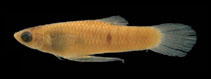
Klassifizierung / Names
Namen | Synonyme | Catalog of Fishes(Gattung, Arten) | ITIS | CoL | WoRMS | Cloffa
>
Cyprinodontiformes (Rivulines, killifishes and live bearers) >
Poeciliidae (Poeciliids) > Poeciliinae
Etymology: Phalloceros: Greek, phallos = penis + Greek, keras = horn (Ref. 45335); lucenorum: The specific name lucenorum is a patronym for Carlos A.S. Lucena and Zilda Margarete S. Lucena, in recognition of their many contributions to Neotropical ichthyology.
Eponymy: Dr Zilda Margarete Seixas de Lucena is a zoologist and ichthyologist, as is her husband Dr Carlos Alberto Santos de Lucena (above). [...] (Ref. 128868), visit book page.
Umwelt: Milieu / Klimazone / Tiefenbereich / Verbreitungsgebiet
Ökologie
; süßwasser benthopelagisch. Tropical
South America: Rio Juquiá, a tributary to the drainage of the rio Ribeira de Iguape in São Paulo, Brazil.
Größe / Gewicht / Alter
Geschlechtsreife: Lm ? range ? - ? cm
Max length : 2.8 cm SL Männchen/unbestimmt; (Ref. 76852); 3.7 cm SL (female)
Kurzbeschreibung
Bestimmungsschlüssel | Morphologie | Morphometrie
Rückenflossenweichstrahlen (insgesamt) : 7 - 8; Afterflossenweichstrahlen: 9 - 11; Wirbelzahl: 31 - 32. Diagnosed autapomorphically by the rectangular tip of hook on left half of gonopodial appendix (vs. rounded tip). Can be differentiated from its congeners except Phalloceros megapolos, Phalloceros spiloura, Phalloceros malabarbai, Phalloceros alessandrae, Phalloceros buckupi, Phalloceros uai, Phalloceros anisophallos, Phalloceros pellos, and Phalloceros reisi by the female urogenital papilla curved to the right, located laterally (vs. slightly left turned and with a lateral ramus or straight located along midventral line) and border of the anal aperture in contact with the first anal-fin ray or very close to it (vs. separated from first anal-fin ray by the female urogenital papilla). Differs further from its congeners except Phalloceros spiloura, Phalloceros uai, Phalloceros anisophallos, Phalloceros pellos, and Phalloceros reisi by the absence of the right hook and presence of the left one (vs. absence or presence of left and right hooks); and gonopodial appendix asymmetrical, its halves different from each other; right half wider than left one (vs. gonopodial appendix symmetrical; its halves similar to each other). Can be separated from Phalloceros spiloura by the absence of a caudal peduncle spot (vs. presence of caudal peduncle spot); from Phalloceros uai by the presence of a wide and square-shaped lateral spot in large specimens (vs. absence of such spot); from Phalloceros anisophallos by the lateral spot in adult females elliptical to roundish, but never forming a vertical bar (vs. lateral spot very narrow, forming a vertically elongated bar covering up to the length corresponding to two scales length in horizontal direction and 2-4 scales in vertical direction); from Phalloceros reisi by lateral spot always present and evident not covering the length corresponding to more than two scales length in horizontal or vertical directions (vs. lateral spot absent or small and discrete not covering the length corresponding to one or two scales length in horizontal or vertical directions) (Ref. 76852).
Lebenszyklus und Paarungsverhalten
Geschlechtsreife | Fortpflanzung | Ablaichen | Eier | Fruchtbarkeit | Larven
Lucinda, P.H.F., 2008. Systematics and biogeography of the genus Phalloceros Eigenmann, 1907 (Cyprinodontiformes: Poeciliidae: Poeciliinae), with the description of twenty-one new species. Neotrop. Ichthyol. 6(2):113-158. (Ref. 76852)
IUCN Rote Liste Status (Ref. 130435: Version 2025-2 (Global))
Bedrohung für Menschen
Harmless
Nutzung durch Menschen
Tools
Zusatzinformationen
Download XML
Internet Quellen
Schätzungen auf der Grundlage von Modellen
Phylogenetischer Diversitätsindex (Ref.
82804): PD
50 = 0.5000 [Uniqueness, from 0.5 = low to 2.0 = high].
Bayesian length-weight: a=0.00851 (0.00369 - 0.01962), b=3.15 (2.96 - 3.34), in cm total length, based on LWR estimates for this (Sub)family-body shape (Ref.
93245).
Trophische Ebene (Ref.
69278): 3.0 ±0.4 se; based on size and trophs of closest relatives
Widerstandsfähigkeit (Ref.
120179): hoch, Verdopplung der Population dauert weniger als 15 Monate. (Preliminary K or Fecundity.).
Anfälligkeit der Fischerei (Ref.
59153): Low vulnerability (10 of 100).
🛈