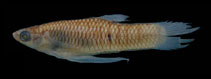
Classificazione / Nomi
Nomi Comuni | Sinonimi | Catalog of Fishes(Genere, Specie) | ITIS | CoL | WoRMS | Cloffa
>
Cyprinodontiformes (Rivulines, killifishes and live bearers) >
Poeciliidae (Poeciliids) > Poeciliinae
Etymology: Phalloceros: Greek, phallos = penis + Greek, keras = horn (Ref. 45335).
Ambiente: milieu / zona climatica / distribuzione batimetrica / gamma di distribuzione
Ecologia
; acqua dolce benthopelagico. Tropical
South America: Brazil in the drainages of rio Parati, rio Barra Grande, rio São Roque, rio Taquari and rio Itinguçu (small coastal drainages of Rio de Janeiro).
Dimensione / Peso / Età
Maturità: Lm ? range ? - ? cm
Max length : 2.8 cm SL maschio/sesso non determinato; (Ref. 76852); 4.5 cm SL (female)
Breve descrizione
Chiavi di identificazione | Morfologia | Morfometria
Raggi dorsali molli (totale) : 7 - 8; Raggi anali molli: 9 - 11; Vertebre: 32. Autapomorphically diagnosed by having hook on left half of gonopodial appendix near its tip, located approximately from distal quarter to the distal third of length of gonopodial appendix, and spot on median region of flanks elongate, forming a vertical bar reaching dorsal and ventral profiles. Differs from its congeners but Phalloceros megapolos,
Phalloceros spiloura, Phalloceros malabarbai, Phalloceros alessandrae, Phalloceros buckupi, Phalloceros uai, Phalloceros lucenorum, Phalloceros pellos, and Phalloceros reisi by the female urogenital papilla curved to the right, located laterally (vs. slightly left turned and with a lateral ramus or straight located along midventral line); and border of the anal aperture in contact with the first anal-fin ray or very close to it (vs. separated from first anal-fin ray by the female urogenital papilla). Can be differentiated from its congeners except Phalloceros spiloura, Phalloceros uai, Phalloceros lucenorum, Phalloceros pellos, and Phalloceros reisi by the absence of the right hook and presence of the left one (vs. absence or presence of left and right hooks), and gonopodial appendix asymmetrical; its halves different from each other; right half wider than left one (vs. gonopodial appendix symmetrical; its halves similar to each other). Can be separated from Phalloceros spiloura by the absence of a caudal peduncle spot (vs. presence of caudal peduncle spot); from Phalloceros uai by the presence of a wide and square-shaped lateral spot in large specimens (vs. absence of such spot); from Phalloceros lucenorum by rectangular tip of hook on left half of gonopodial appendix (vs. rounded tip); from Phalloceros lucenorum, Phalloceros pellos, and Phalloceros reisi by the lateral spot in adult females very narrow, forming a vertically elongated bar covering up to the length corresponding to two scales length in horizontal direction and 2-4 scales in vertical direction (vs. lateral spot in adult females absent, small, or elliptical to roundish, but never forming a vertical bar) (Ref. 76852).
Ciclo vitale e comportamento di accoppiamento
Maturità | Riproduzione | Deposizione | Uova | Fecondità | Larve
Lucinda, P.H.F., 2008. Systematics and biogeography of the genus Phalloceros Eigenmann, 1907 (Cyprinodontiformes: Poeciliidae: Poeciliinae), with the description of twenty-one new species. Neotrop. Ichthyol. 6(2):113-158. (Ref. 76852)
Stato della Lista Rossa IUCN (Ref. 130435: Version 2025-2 (Global))
Minaccia per l'uomo
Harmless
Usi umani
Strumenti
Rapporti speciali
Scarica XML
Fonti Internet
Stime basate su modelli
Indice di diversità filogenetica (Fonte Biblio.
82804): PD
50 = 0.5000 [Uniqueness, from 0.5 = low to 2.0 = high].
Bayesian length-weight: a=0.00851 (0.00369 - 0.01962), b=3.15 (2.96 - 3.34), in cm total length, based on LWR estimates for this (Sub)family-body shape (Ref.
93245).
Livello trofico (Fonte Biblio.
69278): 3.0 ±0.4 se; based on size and trophs of closest relatives
Resilienza (Fonte Biblio.
120179): Alto, tempo minimo di raddoppiamento della popolazione meno di 15 mesi (Preliminary K or Fecundity.).
Vulnerabilità della pesca (Ref.
59153): Low vulnerability (10 of 100).
🛈