>
Cypriniformes (Carps) >
Gobionidae (Gudgeons)
Etymology: Gobio: Latin, gobius = gudgeon (Ref. 45335); volgensis: The specific name volgensis refers to the range of the species.
Meio ambiente: milieu / Zona climática / intervalo de profundidade / faixa de distribuição
Ecologia
; Água doce bentopelágico. Temperate
Europe: known only from the Volga River basin in Russia.
Tamanho / Peso / Idade
Maturidade: Lm ? range ? - ? cm
Max length : 9.2 cm SL macho/indeterminado; (Ref. 76908)
Descrição suscinta
Chaves de identificação | Morfologia | Morfometria
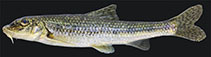
Espinhos dorsais (total) : 2 - 3; Raios dorsais (total) : 8; Espinhos anais: 2 - 3; Raios anais : 6 - 7; Vértebras: 40. Can be distinguished by the following characters: body and caudal peduncle moderately compressed; the minimum body depth is somewhat smaller than the width of the caudal peduncle at the level of the last anal ray in larger specimens and somewhat greater in smaller fishes; the anus is closer to the insertion of the anal fin than to the origin of the pelvic fins; absence of epithelial crests on the dorsal scales and absence of barbellike prolongations at the corners of the mouth; barbels are moderately long, usually extending beyond the anterior edge of the eye (only rarely do they not reach anterior eye edge), sometimes reaching up to the middle of the eye, but never reach to its posterior edge; the barbel length ranges from 15% to 28% of the head length with modal values between 21% and 22%; paired fins are moderately long: pectoral fins never reach the pelvic fin insertion, and their average length varies from 74.7% to 84.8% of the distance between the base of paired fins; ventral fins never reach the anal fin insertion, and their average length varies from 72.8% to 75.7% of the distance between ventral and anal fin bases; there are large, more or less rounded, dark spots located along the lateral line and several rows of small dark spots on the dorsal and caudal fins; large eye with a diameter greater than ¾ of the interorbital distance; the breast in front of the level of the rear extent of the pelvic fin insertions usually lacks scales; the lateral branch of the supraorbital cephalic sensory canal (CSO) is connected with the infraorbital canal behind the eye; usually seven pores in the frontoparietal area of CSO and five pores in the pteroticum; both supra and infraorbital bones are wide: the average width of the supraorbital bone exceeds 40% of its length, and the average width of the last infraorbitals comes to more than half of the bone length (Ref. 76908).
Body shape (shape guide): elongated.
Ciclo de vida ou comportamento de acasalamento
Maturidade | Reprodução | Desova | Ovos | Fecundidade | Larvas
Mendel, J., S. Lusk, E.K. Vasil'eva, V.P. Vasil'ev, V. Lusková, F.G. Ekmekci, F. Erk'akan, A. Ruchin, J. Kosco, L. Vetesnik, K. Halacka, R. Šanda, A.N. Pashkov and S.I. Reshetnikov, 2008. Molecular phylogeny of the genus Gobio Cuvier, 1816 (Teleostei: Cyprinidae) and its contribution to taxonomy. Mol. Phylo. Evol. 47:1061-1075. (Ref. 76908)
Status na Lista Vermelha da UICN (Ref. 130435: Version 2025-2 (Global))
Ameaça para os humanos
Harmless
Uso pelos humanos
Ferramentas
Relatórios especiais
Baixar XML
Fontes da internet
Estimativas baseadas em modelos
Índice de diversidade filogenética (Ref.
82804): PD
50 = 0.5000 [Uniqueness, from 0.5 = low to 2.0 = high].
Bayesian length-weight: a=0.00708 (0.00306 - 0.01639), b=3.12 (2.95 - 3.29), in cm total length, based on LWR estimates for this Genus-body shape (Ref.
93245).
Nível Trófico (Ref.
69278): 3.2 ±0.4 se; based on size and trophs of closest relatives
Resiliência (Ref.
120179): Elevada, tempo mínimo de duplicação da população menor que 15 meses (Preliminary K or Fecundity.).
Vulnerabilidade da pesca (Ref.
59153): Low vulnerability (10 of 100).
🛈