Klassifizierung / Names
Namen | Synonyme | Catalog of Fishes(Gattung, Arten) | ITIS | CoL | WoRMS | Cloffa
Elasmobranchii (Haie und Rochen) (sharks and rays) >
Carcharhiniformes (Ground sharks) >
Pentanchidae (Deepwater catsharks)
Etymology: Bythaelurus: bythos (Gr.), depths of the sea, referring to its deepwater habitat; ailouros (Gr.), cat, probably an allusion to the vernacular “catshark,” so named for its cat-like eyes (See ETYFish); incanus: Latin for quite gray, referring to its body and fin coloration (See ETYFish).
More on authors: Last & Stevens.
Umwelt: Milieu / Klimazone / Tiefenbereich / Verbreitungsgebiet
Ökologie
seewasser bathydemersal; tiefenbereich 900 - 1000 m (Ref. 76945). Deep-water
Eastern Indian Ocean: Australia.
Größe / Gewicht / Alter
Geschlechtsreife: Lm ? range ? - ? cm
Max length : 45.4 cm TL Männchen/unbestimmt; (Ref. 76945)
Kurzbeschreibung
Bestimmungsschlüssel | Morphologie | Morphometrie
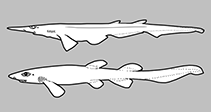
This species possess the following set of characters: short and broad head, its width 13.5% TL, length 19.1% TL; short snout, broadly rounded, its length 2.5 in head length; triangular anterior nasal flaps; large mouth, its width 10.3% TL, length 4.6% TL; short labial furrows confined to mouth corners; small papillae on roof of mouth; elongate abdomen, the pectoral-pelvic space 2.8 times length of pectoral-fin anterior margin, 1.7 times interdorsal space; distance of pre-dorsal about 42% TL, 10.9 times eye length; distance of anal-caudal 6.3% TL; origin of first dorsal-fin slightly behind origin of pelvic fin, while the origin of the second is well behind anal-fin mid-base; length of anal-fin base 1.2 times the second dorsal-fin base length, subequal to interdorsal space; weakly tricuspidate flank denticles, very slender crowns, their length more than twice their width; minute teeth mainly with 4 small cusps, central pair longer than those adjacent, about 100 rows in each jaw; upright flank denticles weakly tricuspidate; precaudal centra about 93, before upper caudal-fin origin; uniformly greyish brown body (Ref. 76945).
Body shape (shape guide): elongated.
Lebenszyklus und Paarungsverhalten
Geschlechtsreife | Fortpflanzung | Ablaichen | Eier | Fruchtbarkeit | Larven
Last, P.R. and J.D. Stevens, 2008. Bythaelurus incanus sp. nov., a new deepwater catshark (Carcharhiniformes: Scyliorhinidae) from Northwestern Australia. pp. 123-128. In Last, P.R., White, W.T. & Pogonoski, J.J. (eds.): Descriptions of New Australian Chondrichthyans. CSIRO Marine and Atmospheric Research Paper no. 22. (Ref. 76945)
IUCN Rote Liste Status (Ref. 130435: Version 2025-2 (Global))
Bedrohung für Menschen
Harmless
Nutzung durch Menschen
Tools
Zusatzinformationen
Download XML
Internet Quellen
Schätzungen auf der Grundlage von Modellen
Phylogenetischer Diversitätsindex (Ref.
82804): PD
50 = 0.5001 [Uniqueness, from 0.5 = low to 2.0 = high].
Bayesian length-weight: a=0.00347 (0.00172 - 0.00698), b=3.08 (2.90 - 3.26), in cm total length, based on LWR estimates for this (Sub)family-body shape (Ref.
93245).
Trophische Ebene (Ref.
69278): 4.3 ±0.5 se; based on size and trophs of closest relatives
Widerstandsfähigkeit (Ref.
120179): niedrig, Verdopplung der Population dauert 4,5 - 14 Jahre. (Preliminary low fecundity).
Anfälligkeit der Fischerei (Ref.
59153): Moderate vulnerability (35 of 100).
🛈