Elasmobranquios (tiburones y rayas) (sharks and rays) >
Carcharhiniformes (Ground sharks) >
Scyliorhinidae (Cat sharks) > Scyliorhininae
Etymology: Cephaloscyllium: cephalus, from kephale (Gr.), head, referring to its very broad and depressed head; skylion, Greek for dogfish or small shark (See ETYFish); signourum: signa, from signum (L.), flag; oura (Gr.), tail, but used here as an adjective (tailed), referring to distinctive flag-like dark marking on terminal lobe of caudal fin (See ETYFish).
More on authors: Last, Séret & White.
Entorno: milieu / zona climática / rango de profundidad / gama de distribución
Ecología
marino bentopelágico; rango de profundidad 480 - 700 m (Ref. 76946). Tropical
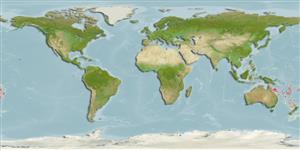
Western Pacific: Australia; possibly occurring off the islands of New Caledonia, Fiji, and Vanuatu.
Tamaño / Peso / Edad
Madurez: Lm ? range ? - ? cm
Max length : 74.1 cm TL (female)
Descripción breve
Claves de identificación | Morfología | Morfometría
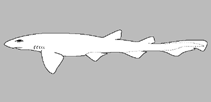
This medium-sized species has the following set of characters which was based on the holotype: head 7.5% TL in height, trunk 16.3% TL in width; origin of first dorsal-fin is over the anterior pelvic-fin base; prenarial 3.6% TL in length; preorbital snout length is 2.0 times prenarial length, 3.0 in prepectoral length, 6.6 in prepelvic length; snout-vent length long, 51.7% TL; nostril width 2.7% TL; eye-spiracle space narrow, 0.5% TL; pectoral fin medium-sized, its height 12.8% TL, posterior margin 11.9% TL; anal fin tall, 4.0% TL; anal-caudal space is 5.0% TL; precaudal length is 76% TL; interdorsal space is 6.6% TL; teeth with 3 well-developed cusps near symphysis of upper jaw; mostly unicuspidate flank denticles; back without the greatly enlarged denticles; adult clasper unknown; vertebral centra 115-116; tooth count high, 84 teeth in upper jaws, 97 in lower jaws; color of upper half of body medium brown, with a variegated pattern that is not clearly demarcated from the ventral surface; dark saddles (10) evident on body and tail; dorsal fins are pale variegated; dark blotch absent over gills; marking on posterior margin of terminal lobe of caudal fin dark, anteriorly directed, V-shaped; upper surface of pectoral-fin with a dark brown central blotch; centered over ventral origin of caudal fin is a well-developed saddle; ventral surface is uniformly greyish or white in color; juveniles are pale with dark transverse markings appearing as narrow bars and hollow saddles; markings between spiracles not separated into two unconnected pseudo-ocelli (Ref. 76946).
Body shape (shape guide): elongated.
Ciclo vital y comportamiento de apareamiento
Madurez | Reproducción | Puesta | Huevos | Fecundidad | Larva
Last, P.R., B. Séret and W.T. White, 2008. New swellsharks (Cephaloscyllium: Scyliorhinidae) from the Indo-Australian region. In Last, P.R., White, W.T. & Pogonoski, J.J. (eds.): Descriptions of New Australian Chondrichthyans. CSIRO Marine and Atmospheric Research Paper no. 22. (Ref. 76946)
Situación en la Lista Roja de la UICN (Ref. 130435: Version 2025-2 (Global))
Amenaza para el ser humano
Harmless
Usos humanos
Herramientas
Informes especiales
Descargar XML
Fuentes de Internet
Estimaciones basadas en modelos
Temperatura preferida (Referencia
123201): 6.2 - 10.2, mean 7.7 °C (based on 119 cells).
Índice de diversidad filogenética (Referencia
82804): PD
50 = 0.5000 [Uniqueness, from 0.5 = low to 2.0 = high].
Bayesian length-weight: a=0.00269 (0.00140 - 0.00518), b=3.21 (3.04 - 3.38), in cm total length, based on LWR estimates for this (Sub)family-body shape (Ref.
93245).
Nivel trófico (Referencia
69278): 4.1 ±0.5 se; based on size and trophs of closest relatives
Resiliencia (Referencia
120179): Bajo, población duplicada en un tiempo mínimo de 4.5-14 años (Preliminary K or Fecundity.).
Vulnerabilidad pesquera (Ref.
59153): Moderate to high vulnerability (50 of 100).
🛈