Élasmobranches (requins et raies) (sharks and rays) >
Carcharhiniformes (Ground sharks) >
Scyliorhinidae (Cat sharks) > Scyliorhininae
Etymology: Cephaloscyllium: cephalus, from kephale (Gr.), head, referring to its very broad and depressed head; skylion, Greek for dogfish or small shark (See ETYFish); speccum: From specca (L.), speckled, referring to dark brown spots and blotches that dominate its color pattern (See ETYFish).
More on authors: Last, Séret & White.
Environnement : milieu / zone climatique / profondeur / gamme de distribution
Écologie
marin benthopélagique; profondeur 150 - 455 m (Ref. 76946). Tropical
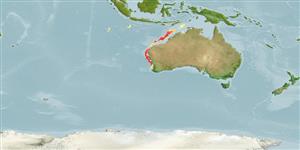
Eastern Indian Ocean: Australia.
Longueur à la première maturité / Taille / Poids / Âge
Maturité: Lm ?, range 64 - ? cm
Max length : 68.0 cm TL mâle / non sexé; (Ref. 76946); 69.4 cm TL (female)
Description synthétique
Clés d'identification | Morphologie | Morphométrie
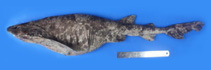
A medium-sized species with the following characters: head 7.8-12.5% TL in height, trunk width 13.0-16.8% TL; origin of first dorsal-fin mostly over posterior of pelvic-fin base; prenarial 3.6-4.9% TL in length; preorbital snout length 1.5-2.0 times prenarial length, 2.6-3.1 in prepectoral length, 5.9-7.1 in prepelvic length; snout-vent length long, 47.4-51.1% TL; nostril 2.2-2.7% TL in width; eye-spiracle space narrow, 0.4-1.0% TL; pectoral fin medium-sized, height 8.9-13.8% TL, posterior margin 8.5-13.3% TL; anal fin tall, 3.2-4.4% TL; anal-caudal space 4.5-6.1% TL; precaudal 76-78% TL in length; interdorsal space 6.5-8.6% TL; teeth have 3-5 cusps; unicuspidate or weakly tricuspidate flank denticles; back with no greatly enlarged denticles; adult clasper long, outer length about 7% TL, well short of anal fin, interspace about 1.9% TL; vertebral centra 111-115; tooth count relatively high, 69-97 teeth in each jaw; color of upper half of body pale, with a strongly variegated pattern that is well-demarcated from the ventral surface; dark saddles (8) evident on body and caudal fin; pale variegated dorsal fins; dark blotch over gills absent; distinct V-shaped marking on posterior margin of terminal lobe of caudal fin absent; upper surfaces of pectoral and pelvic-fin without a dark central blotch; without dark saddle extending onto caudal peduncle above origin of ventral lobe of caudal fin; uniformly pale on the ventral surface; color of juveniles pale, with dark lines and spots forming rosettes and linear saddle markings, and the markings between spiracles separated into two unconnected pseudo-ocelli (Ref. 76946).
Body shape (shape guide): elongated.
Cycle de vie et comportement reproducteur
Maturité | Reproduction | Frai | Œufs | Fécondité | Larves
Last, P.R., B. Séret and W.T. White, 2008. New swellsharks (Cephaloscyllium: Scyliorhinidae) from the Indo-Australian region. In Last, P.R., White, W.T. & Pogonoski, J.J. (eds.): Descriptions of New Australian Chondrichthyans. CSIRO Marine and Atmospheric Research Paper no. 22. (Ref. 76946)
Statut dans la liste rouge de l'IUCN (Ref. 130435: Version 2025-2 (Global))
Menace pour l'homme
Harmless
Utilisations par l'homme
Outils
Articles particuliers
Télécharger en XML
Sources Internet
Estimations basées sur des modèles
Température préférée (Réf.
123201): 11.4 - 16.5, mean 13.4 °C (based on 21 cells).
Indice de diversité phylogénétique (Réf.
82804): PD
50 = 0.5000 [Uniqueness, from 0.5 = low to 2.0 = high].
Bayesian length-weight: a=0.00269 (0.00140 - 0.00518), b=3.21 (3.04 - 3.38), in cm total length, based on LWR estimates for this (Sub)family-body shape (Ref.
93245).
Niveau trophique (Réf.
69278): 4.1 ±0.5 se; based on size and trophs of closest relatives
Résilience (Réf.
120179): Faible, temps minimum de doublement de population : 4,5 à 14 années (Preliminary low fecundity).
Vulnérabilité de la pêche (Ref.
59153): Moderate to high vulnerability (48 of 100).
🛈