Elasmobranchii (haaien en roggen) (sharks and rays) >
Carcharhiniformes (Ground sharks) >
Scyliorhinidae (Cat sharks) > Scyliorhininae
Etymology: Cephaloscyllium: cephalus, from kephale (Gr.), head, referring to its very broad and depressed head; skylion, Greek for dogfish or small shark (See ETYFish); zebrum: Derived from the Amharic zebra, referring to zebra-like narrow bars on dorsal and lateral surfaces of head and body (See ETYFish).
More on authors: Last & White.
Milieu: milieu / Klimaatzone / Diepte / verspreidingsgebied
Ecologie
marien bathypelagisch; diepte ? - 454 m (Ref. 76948). Tropical
Western Pacific: Australia.
Grootte / Gewicht / Leeftijd
Maturiteit: Lm ? range ? - ? cm
Max length : 44.5 cm TL mannelijk / geslacht onbekend; (Ref. 76948); 43.5 cm TL (female)
Korte beschrijving
Determinatiesleutels | Morfologie | Morfometrie
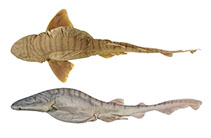
A small species with the following set of characters: head 10.2-11.1% TL in height, trunk narrow, its width 14.7-15.7% TL; origin of first dorsal-fin slightly behind mid pelvic-fin base; prenarial 4.4-4.8% TL in length; preorbital snout length is 1.5 times prenarial length, 2.8-2.9 in prepectoral length, about 6.3 in prepelvic length; snout-vent, 49.4-50.3% TL in length; nostril 2.2-2.4% TL in width; eye-spiracle space is wide, 1.1-1.3% TL; height of pectoral fin 11.3-12.1% TL, posterior margin length 10.6-11.6% TL; height of anal fin 3.2-3.3% TL; anal-caudal space about 5.4% TL; precaudal length 75-76% TL; interdorsal space 6.2-7.7% TL; teeth often with 3-5 cusps near symphysis of upper jaw; flank denticles are unicuspidate or weakly tricuspidate; back with no greatly enlarged denticles; adult clasper is long, up to 8.2% TL, almost reaching anal fin, interspace about 3.9 in anal-fin base; vertebral centra 110-111; low tooth count, each jaw with 59-62 teeth; upper half is pale with 31-34 narrow, saddle-like bars on body and tail; broad interspaces between bars, about 1.5 times width of adjacent bar; no large blotches (Ref. 76948).
Body shape (shape guide): elongated.
Levenscyclus en paargedrag
Maturiteit | Voortplanting | Paaien | Eieren | Fecunditeit | Larven
Last, P.R. and W.T. White, 2008. Two new saddled swellsharks (Cephaloscyllium: Scyliorhinidae) from Eastern Australia. In Last, P.R., White, W.T. & Pogonoski, J.J. (eds.): Descriptions of New Australian Chondrichthyans. CSIRO Marine and Atmospheric Research Paper no. 22. (Ref. 76948)
Status op de Rode Lijst van het IUCN (Ref. 130435: Version 2025-2 (Global))
Gevaar voor de mens
Harmless
Gebruik door de mens
Tools
Speciale rapporten
Download XML
Internetbronnen
Schattingen op basis van modellen
Fylogenetische diversiteitsindex (Ref.
82804): PD
50 = 0.5000 [Uniqueness, from 0.5 = low to 2.0 = high].
Bayesian length-weight: a=0.00269 (0.00140 - 0.00518), b=3.21 (3.04 - 3.38), in cm total length, based on LWR estimates for this (Sub)family-body shape (Ref.
93245).
Trofisch niveau (Ref.
69278): 4.0 ±0.5 se; based on size and trophs of closest relatives
Weerstandsvermogen (Ref.
120179): laag, minimale populatieverdubbelingstijd 4,5-14 jaar (Preliminary low fecundity).
Kwetsbaarheid van de visserij (Ref.
59153): Low to moderate vulnerability (35 of 100).
🛈