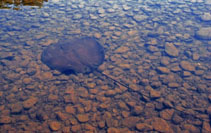
Élasmobranches (requins et raies) (sharks and rays) >
Myliobatiformes (Stingrays) >
Dasyatidae (Stingrays) > Urogymninae
Etymology: Urogymnus: Greek, oura = tail + Greek, gymnos = naked (Ref. 45335); dalyensis: Named for the major Northern Australian river where the first confirmed species was first collected (Daly River, NT).
More on authors: Last & Manjaji-Matsumoto.
Environnement : milieu / zone climatique / profondeur / gamme de distribution
Écologie
marin; eau douce; saumâtre benthopélagique; profondeur 1 - 4 m (Ref. 76960). Tropical
Oceania: Australia.
Taille / Poids / Âge
Maturité: Lm ? range ? - ? cm
Max length : 124 cm WD mâle / non sexé; (Ref. 76960)
This benthic species is found mainly in rivers, estuaries and low salinity coastal environments. It feeds mainly on small fishes and prawns, which it actively pursues, even beaching itself to trap prey (Ref. 114953).
Cycle de vie et comportement reproducteur
Maturité | Reproduction | Frai | Œufs | Fécondité | Larves
Last, P.R. and B.M. Manjaji-Matsumoto, 2008. Himantura dalyensis sp. nov., a new estuarine whipray (Myliobatoidei: Dasyatidae) from Northern Australia. In Last, P.R., White, W.T. & Pogonoski, J.J. (eds.): Descriptions of New Australian Chondrichthyans. CSIRO Marine and Atmospheric Research Paper no. 22. (Ref. 76960)
Statut dans la liste rouge de l'IUCN (Ref. 130435: Version 2025-2 (Global))
Menace pour l'homme
Harmless
Utilisations par l'homme
Outils
Articles particuliers
Télécharger en XML
Sources Internet
Estimations basées sur des modèles
Indice de diversité phylogénétique (Réf.
82804): PD
50 = 0.5156 [Uniqueness, from 0.5 = low to 2.0 = high].
Bayesian length-weight: a=0.01023 (0.00482 - 0.02174), b=3.06 (2.86 - 3.26), in cm total length, based on LWR estimates for this (Sub)family-body shape (Ref.
93245).
Niveau trophique (Réf.
69278): 3.5 ±0.4 se; based on size and trophs of closest relatives
Vulnérabilité de la pêche (Ref.
59153): Very high vulnerability (90 of 100).
🛈