Elasmobranquios (tiburones y rayas) (sharks and rays) >
Myliobatiformes (Stingrays) >
Dasyatidae (Stingrays) > Urogymninae
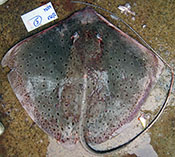
Etymology: astra: Name from Latin 'astrum' for star or constellation, refers to the dorsal coloration, which usually consists of dark spots orbited in various ways by whitish spots, vaguely resembling a cluster of stars, evident in larger specimens.
More on authors: Last, Manjaji-Matsumoto & Pogonoski.
Entorno: milieu / zona climática / rango de profundidad / gama de distribución
Ecología
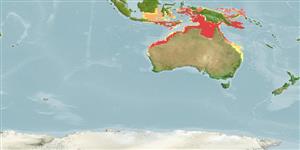
marino bentopelágico; rango de profundidad 1 - 141 m (Ref. 76963). Tropical; 1°S - 29°S, 111°E - 155°E (Ref. 114953)
Indo-West Pacific: Australia, to West Papua, Indonesia; including Timor Sea (Ref. 76936); southern New Guinea (Ref. 114953).
Longitud en la primera madurez / Tamaño / Peso / Edad
Madurez: Lm ?, range 50 - ? cm
Max length : 180 cm WD macho / no sexado; (Ref. 76963)
A demersal species found inshore, over muddy bottoms or mangrove flats to 140 m depth. Litters of 1-3 pups. Feeds mainly on prawns and crabs (Ref. 114953). Birth size for this species is about 17-19 cm WD (Ref. 76963).
Ciclo vital y comportamiento de apareamiento
Madurez | Reproducción | Puesta | Huevos | Fecundidad | Larva
Last, P.R., B.M. Majajii-Matsumoto and J.J. Pogonoski, 2008. Himantura astra sp. Nov., a new whipray (Myliobatoidei: Dasyatidae) from Northern Australia. In Last, P.R., White, W.T. & Pogonoski, J.J. (eds.): Descriptions of New Australian Chondrichthyans. CSIRO Marine and Atmospheric Research Paper no. 22. (Ref. 76963)
Situación en la Lista Roja de la UICN (Ref. 130435: Version 2025-2 (Global))
Amenaza para el ser humano
Harmless
Usos humanos
Herramientas
Informes especiales
Descargar XML
Fuentes de Internet
Estimaciones basadas en modelos
Temperatura preferida (Referencia
123201): 24.5 - 28.8, mean 27.7 °C (based on 748 cells).
Índice de diversidad filogenética (Referencia
82804): PD
50 = 0.5020 [Uniqueness, from 0.5 = low to 2.0 = high].
Bayesian length-weight: a=0.01023 (0.00482 - 0.02174), b=3.06 (2.86 - 3.26), in cm total length, based on LWR estimates for this (Sub)family-body shape (Ref.
93245).
Nivel trófico (Referencia
69278): 3.7 ±0.4 se; based on size and trophs of closest relatives
Vulnerabilidad pesquera (Ref.
59153): Very high vulnerability (90 of 100).
🛈