klasifikasi / Nama
Nama-nama umum | Sinonim (persamaan) | Catalog of Fishes(Marga, Jenis) | ITIS | CoL | WoRMS | Cloffa
>
Ovalentaria/misc (Various families in series Ovalentaria) >
Pomacentridae (Damselfishes) > Pomacentrinae
Etymology: Amphiprion: Greek, amphi = on both sides + Greek, prion, -onos = saw (Ref. 45335); barberi: Named for Dr. Paul Barber of Boston University, USA, for his contributions regarding genetic relationships of Indo-Pacific coral reef organisms.
Eponymy: Dr Paul Henry Barber is an American evolutionary biologist and ecologist. [...] (Ref. 128868), visit book page.
Lingkungan: lingkungan / zona iklim / kisaran kedalaman / jangkauan distribusi
Ekologi
laut berasosiasi dengan karang; kisaran kedalaman 2 - 10 m (Ref. 78105). Tropical
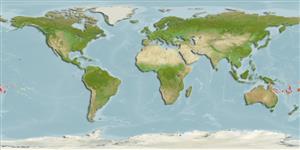
Central Pacific: Fiji, Tonga and American Samoa.
Ukuran / Berat / umur
Kematangan: Lm ? range ? - ? cm
Max length : 8.6 cm SL jantan/; (Ref. 78105)
deskripsi pendek
Kunci identifiaksi (pengenalan) | Morfologi | Morfometrik
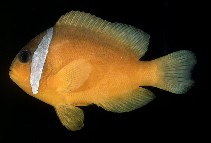
Duri punggung (Keseluruhan (total)) : 10; duri punggung lunak (Keseluruhan (total)) : 16 - 18; Duri dubur: 2; Sirip dubur lunak: 14. This pomacentrid species is distinguished by the following characters: D X, 16-18 (usually X, 17); A II, 14; pectoral rays 18 (rarely 17); tubed lateral-line scales 36-43; gill rakers 5 + 12-14 (total 17-19); opercular spinules 11-19; body depth 1.7-1.9 in SL; body color generally red-orange including fins, grading to brownish on upper back of adults and a single white bar immediately posterior to the eye, its greatest width equal to that of eye or greater, narrowing to one-third to one-half of greatest width at dorsal midline (Ref. 78105).
The species is common on coral reefs, about 2-10 m and is generally commensal with large sea anemones, either Entacmaea quadricolor (Rüppell & Leuckart, 1828) or
Heteractis crispa (Ehrenberg, 1834). It is usually seen in groups that swim a short distance above their host anemones, apparently feeding on zooplankton. Reported to have been frequently encountered on local reefs in about 6-8 m depth, usually in association with Entacmaea quadricolor (Paul Brown, National Park of American Samoa, pers.comm.) (Ref. 78105). Oviparous, distinct pairing during breeding (Ref. 205). Eggs are demersal and adhere to the substrate (Ref. 205). Males guard and aerate the eggs (Ref. 205).
Siklus hidup dan perilaku kawin
Kematangan | Reproduksi, perkembang biakan | Pemijahan | telur-telur | Fekunditas | Larva
Oviparous, distinct pairing during breeding (Ref. 205). Eggs are demersal and adhere to the substrate (Ref. 205). Males guard and aerate the eggs (Ref. 205).
Allen, G.R., J. Drew and L. Kaufman, 2008. Amphiprion barberi, a new species of anemonefish (Pomacentridae) from Fiji, Tonga, and Samoa. aqua, Int. J. Ichthyol. 14(3):105-114. (Ref. 78105)
Status IUCN Red List (Ref. 130435: Version 2025-2 (Global))
ancaman kepada manusia
Harmless
penggunaan manusia
Alat, peralatan
laporan khas
muat turun XML
Sumber internet
Estimasi berdasarkan model
Suhu yang disukai (Acuan
123201): 25.8 - 29, mean 27 °C (based on 256 cells).
Indeks keanekaragaman filogenetik (Acuan
82804): PD
50 = 0.5000 [Uniqueness, from 0.5 = low to 2.0 = high].
Bayesian length-weight: a=0.02344 (0.01149 - 0.04783), b=2.98 (2.80 - 3.16), in cm total length, based on LWR estimates for this (Sub)family-body shape (Ref.
93245).
Tingkat Trofik (Acuan
69278): 2.7 ±0.3 se; based on size and trophs of closest relatives
Daya lenting (Acuan
120179): Tinggi, Waktu penggandaan populasi minimum kurang dari 15 bulan (Preliminary K or Fecundity.).
Kerentanan Penangkapan Ikan (Ref.
59153): Low vulnerability (10 of 100).
🛈