Clasificación / Nombres
Nombres comunes | Sinónimos | Catalog of Fishes(Género, Especie) | ITIS | CoL | WoRMS | Cloffa
>
Gymnotiformes (Knifefishes) >
Apteronotidae (Ghost knifefishes) > Apteronotinae
Etymology: Apteronotus: Greek, apteros = without wings / (in this cases, fins) + Greek, noton = back (Ref. 45335).
Eponymy: Germán Galvis Vergara is a Colombian biologist whose bachelor’s degree was awarded by the University of Strasbourg (1967). [...] (Ref. 128868), visit book page.
Entorno: milieu / zona climática / rango de profundidad / gama de distribución
Ecología
; agua dulce bentopelágico; pH range: 7.3 - ?. Tropical; 27°C - ? (Ref. 75033)
South America: Río Meta basin in Colombia.
Tamaño / Peso / Edad
Madurez: Lm ? range ? - ? cm
Max length : 18.4 cm TL macho / no sexado; (Ref. 75033); 19.0 cm TL (female)
Descripción breve
Claves de identificación | Morfología | Morfometría
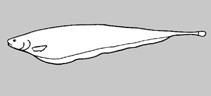
Radios blandos anales: 145 - 165. Distinguished from all congeners by the following combination of characters: hypermorphosis of sphenoid region of the neurocranium in both males and females; ossified lateral ethmoid; uniformly brown body coloration other than for white or yellow band on the chin, dorsal surface of head, and mid-dorsal part of body; presence of a white or yellow band on chin, dorsal surface of head, and mid-dorsal part of body; unpigmented band encircling base of caudal fin. Males differ from the holotype of Apteronotus macrostomus, which is presumably a male, by the following characters: head length 18.6-20.3% of length to end to anal fin [LEA] vs. (21.4); head width 25.3-36.5% of HL (vs. 39.3); head depth at eye 37.9-39.4% of HL (vs. 50.1); snout length 40.0-43.8 % HL (vs. 44.7); and distance from posterior naris to eye 17.8-20.3% of HL (vs. 23.6); width of mouth 40.6-50.1% (vs. 56.2); interocular width 14.1-18.6% HL (vs. 19.9); and postocular distance 49.2-58% HL (vs. 62.1). In addition, males can be separated from the holotype of Apteronotus leptorhynchus, presumably also a male, by the following features: length of anal-fin base 70-79% of LEA (vs. 83.7); head length 18.6-20.3% of LEA (vs. 21); head width 25.3-36.5% of HL (vs. 37.3); and head depth at eye 37.9-39.4 % of HL (43.6) (Ref. 75033).
Inhabits piedmont rivers with clear water, rocky bottom and strong current (Ref. 75033). Has the ability to generate a continuous wave (tone) -type electric organ discharges (EOD) with a stable fundamental frequency of 700-957 (Ref. 75033). Sexually mature males have more fundamental frequencies of the EOD than females, with no overlap between sexes (Ref. 75033).
Ciclo vital y comportamiento de apareamiento
Madurez | Reproducción | Puesta | Huevos | Fecundidad | Larva
de Santana, C.D., J.A. Maldonado-Ocampo and W.G.R. Crampton, 2007. Apteronotus galvisi, a new species of electric ghost knifefish fro the Río Meta basin, Colombia (Gymnotiformes: Apteronotidae). Ichthyol. Explor. Freshwat. 18(2):117-124. (Ref. 75033)
Situación en la Lista Roja de la UICN (Ref. 130435: Version 2025-2 (Global))
Amenaza para el ser humano
Harmless
Usos humanos
Herramientas
Informes especiales
Descargar XML
Fuentes de Internet
Estimaciones basadas en modelos
Índice de diversidad filogenética (Referencia
82804): PD
50 = 0.5000 [Uniqueness, from 0.5 = low to 2.0 = high].
Bayesian length-weight: a=0.00355 (0.00146 - 0.00863), b=3.06 (2.85 - 3.27), in cm total length, based on LWR estimates for this (Sub)family-body shape (Ref.
93245).
Nivel trófico (Referencia
69278): 3.3 ±0.3 se; based on size and trophs of closest relatives
Vulnerabilidad pesquera (Ref.
59153): Low vulnerability (10 of 100).
🛈