Klassifizierung / Names
Namen | Synonyme | Catalog of Fishes(Gattung, Arten) | ITIS | CoL | WoRMS | Cloffa
>
Acanthuriformes (Surgeonfishes) >
Pomacanthidae (Angelfishes)
Etymology: Chaetodontoplus: Greek, chaite = hair + Greek, odous = teeth + Greek, plous, ous, oo = crossing (Ref. 45335); vanderloosi: Named for Mr. Robert Vanderloos, who collected the holotype.
Umwelt: Milieu / Klimazone / Tiefenbereich / Verbreitungsgebiet
Ökologie
seewasser riff-verbunden; tiefenbereich 6 - 9 m (Ref. 77039). Tropical
Western Pacific: Papua New Guinea.
Größe / Gewicht / Alter
Geschlechtsreife: Lm ? range ? - ? cm
Max length : 12.5 cm SL Männchen/unbestimmt; (Ref. 77039)
Kurzbeschreibung
Bestimmungsschlüssel | Morphologie | Morphometrie
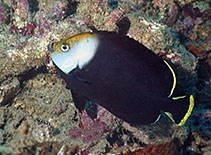
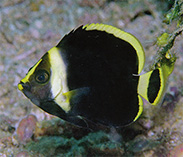
Rückenflossenstacheln (insgesamt) : 8; Rückenflossenweichstrahlen (insgesamt) : 17; Afterflossenstacheln: 3; Afterflossenweichstrahlen: 17; Wirbelzahl: 24. This species is characterized by the following: D XIII, 17; A III, 17; pectoral rays 16-17; tiny scales, about 105-116 diagonal scale rows from upper end of gill opening to base of caudal fin; gill rakers 4-5 +11 on first arch; maximum body depth 1.9-2.0; length of preopercular spine 2.7-4.1 in HL; color of adults mainly black with pale grey head and adjacent dorsoanterior part of body; caudal fin black with broad yellow margin posteriorly; juveniles are mainly black with yellow median band from snout to forehead, yellow diagonal band from front of dorsal fin origin to pelvic fin, broad yellow margin covering most of dorsal fin, and a yellow caudal fin with black submarginal bar (Ref. 77039).
Body shape (shape guide): short and / or deep.
Of all coral reef fishes. this species has one of the most restricted ranges. Occurs in scattered soft and hard corals of rocky bottoms, in vicinity of sunken debris or wharves, in areas of cool upwelling, 22-24 degrees Celsius (Ref. 90102).
Lebenszyklus und Paarungsverhalten
Geschlechtsreife | Fortpflanzung | Ablaichen | Eier | Fruchtbarkeit | Larven
Allen, G.R. and R.C. Steene, 2004. Chaedontoplus vanderloosi, a new species of angelfish (Pomacanthidae) from Papua New Guinea. aqua, J. Ichthyol. Aquat. Biol. 8(1):23-30. (Ref. 77039)
IUCN Rote Liste Status (Ref. 130435: Version 2025-2 (Global))
Bedrohung für Menschen
Harmless
Nutzung durch Menschen
Tools
Zusatzinformationen
Download XML
Internet Quellen
Schätzungen auf der Grundlage von Modellen
Phylogenetischer Diversitätsindex (Ref.
82804): PD
50 = 0.5000 [Uniqueness, from 0.5 = low to 2.0 = high].
Bayesian length-weight: a=0.03020 (0.01316 - 0.06929), b=2.89 (2.70 - 3.08), in cm total length, based on LWR estimates for this (Sub)family-body shape (Ref.
93245).
Widerstandsfähigkeit (Ref.
120179): mittel, Verdopplung der Population dauert 1,4 - 4,4 Jahre. (Preliminary K or Fecundity.).
Anfälligkeit der Fischerei (Ref.
59153): Low vulnerability (10 of 100).
🛈