Classification / Noms
Noms communs | Synonymes | Catalog of Fishes(Genre, Espèce) | ITIS | CoL | WoRMS | Cloffa
>
Cypriniformes (Carps) >
Leuciscidae (Minnows) > Leuciscinae
Etymology: Alburnus: From the city of Al Bura, where the fish was known (Ref. 45335); attalus: Named after Attalus I (269 BC-197 BC), the first king of the Attalid dynasty who ruled Pergamon, a Hellenistic polis in today Turkey, from 241-197 BC.
Eponymy: Attalus I (269–197 BC) ruled Pergamon, a Hellenistic city-state in Asia Minor (now Anatolia, Turkey). The fish is endemic to that area. (Ref. 128868), visit book page.
More on authors: Özuluğ & Freyhof.
Environnement : milieu / zone climatique / profondeur / gamme de distribution
Écologie
; eau douce benthopélagique. Subtropical
Asia: River Bakır drainage in Turkey.
Taille / Poids / Âge
Maturité: Lm ? range ? - ? cm
Max length : 21.7 cm TL mâle / non sexé; (Ref. 125982); poids max. publié: 86.57 g (Ref. 125982)
Description synthétique
Clés d'identification | Morphologie | Morphométrie
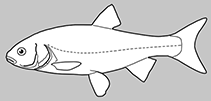
Differs from other species of shemayas in Europe and Asian Black Sea basin by the combination of the following characters: origin of anal fin ½ scale behind dorsal-fin base, below dorsal-fin ray 7-8 individuals larger than 9 cm SL; anal fin with 12-14½ branched rays; gill rakers 23-31; lateral line scales 52-59 + 3; ventral keel exposed for 10-12 scales in front of anus; head length 24-25% SL, 0.9-1.0 times in body depth at dorsal-fin origin; predorsal length 54-57% SL; caudal peduncle depth 9-10% SL, 2.0-2.4 times in its length; caudal peduncle length 20-22% SL; eye diameter 6.3-7.9% SL, 1.0-1.3 times in interorbital distance; body depth at dorsal-fin origin 21-25% SL; faint, dark lateral stripe on body (Ref. 78144).
Body shape (shape guide): fusiform / normal.
Cycle de vie et comportement reproducteur
Maturité | Reproduction | Frai | Œufs | Fécondité | Larves
Özuluǧ, M. and J. Freyhof, 2007. Rediagnosis of four species of Alburnus from Turkey and description of two new species (Teleostei: Cyprinidae). Ichthyol. Explor. Freshwat. 18(3):233-246. (Ref. 78144)
Statut dans la liste rouge de l'IUCN (Ref. 130435: Version 2025-2 (Global))
Menacé (EN) (B2ab(i,ii,iii,iv)); Date assessed: 28 January 2013
Menace pour l'homme
Harmless
Utilisations par l'homme
Outils
Articles particuliers
Télécharger en XML
Sources Internet
Estimations basées sur des modèles
Indice de diversité phylogénétique (Réf.
82804): PD
50 = 0.5000 [Uniqueness, from 0.5 = low to 2.0 = high].
Bayesian length-weight: a=0.00603 (0.00346 - 0.01050), b=3.05 (2.90 - 3.20), in cm total length, based on LWR estimates for this species & Genus-body shape (Ref.
93245).
Niveau trophique (Réf.
69278): 2.7 ±0.3 se; based on size and trophs of closest relatives
Résilience (Réf.
120179): Milieu, temps minimum de doublement de population : 1,4 à 4,4 années (Assuming Fec < 10,000).
Vulnérabilité de la pêche (Ref.
59153): Low vulnerability (12 of 100).
🛈