>
Osteoglossiformes (Bony tongues) >
Mormyridae (Elephantfishes)
Etymology: Marcusenius: Becasue of J. Marcusen, author of "Zur Phauna des Schwarzen Meeres", 1867; ichthyologist; devosi: Marcusenius devosi is named in honour of Dr. Luc De Vos, late curator of fishes at Nairobi Museum, for his contributions to African ichthyology and promotion of ichthyology in East Africa (Ref. 75962).
Eponymy: Dr Johann Andreas Marcusen (1817–1894) was a Latvian of German descent who was a physician, ichthyologist and zoologist. [...] Dr Luc De Vos (1957–2003) was a Belgian ichthyologist who was Curator of Fishes at the Nairobi Museum, Kenya. [...] (Ref. 128868), visit book page.
Ambiente: milieu / zona climatica / distribuzione batimetrica / gamma di distribuzione
Ecologia
; acqua dolce demersale. Tropical
Africa: Tana River, but range extension both to the north and south likely (Ref. 75962).
Dimensione / Peso / Età
Maturità: Lm ? range ? - ? cm
Max length : 121 cm SL maschio/sesso non determinato; (Ref. 75962)
Breve descrizione
Chiavi di identificazione | Morfologia | Morfometria
Spine dorsali (totale) : 0; Raggi dorsali molli (totale) : 21 - 24; Spine anali: 0; Raggi anali molli: 26 - 30. Diagnosis: Marcusenius devosi can be distinguished from its congeners by the following characters: distance dorsal fin origin to end of caudal peduncle 39.5-43.4% of standard length, preanal distance 57.0-61.0% of standard length, predorsal distance 59.8-64.0% of standard length, caudal peduncle length 19.2-22.1% of standard length, number of scales in linear series along the lateral line row 56-66, dorsal fin rays 21-24, anal fin rays 26-30, and 14-18 scales around caudal peduncle (Ref. 75962). Electric organ discharge lacking weak head-negative pre-potential, strong Namp relative to Pamp, but short Ndur, Pdur of long duration (Ref. 75962).
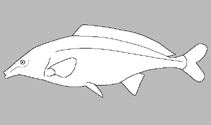
description: Head with terminal mouth well in front of eye, mental lobe on lower jaw protruding beyond upper jaw; head and body dorsolaterally compressed (Ref. 75962). Dorsal fin situated about two thirds of standard length from snout, obliquely orientated, anteriorly higher and posteriorly lower, distal margin sometimes only slightly crescentic with anterior two or three rays longer than posterior rays, number of rays 21-24; anal fin opposite dorsal fin with distinctly more anterior origin, obliquely orientated, anteriorly lower and posteriorly higher, anterior rays longer than posterior ones, especially in males where they also appear stronger and often darkened, distal margin crescentic, number of rays 26-30 (Ref. 75962). Scales cycloid with reticulate striae, scales extending anteriorly to operculum and pectoral fins; scales on caudal peduncle circumference, 14-18 (Ref. 75962). Caudal peduncle relatively deep, subcylindrical enire length, usually 19.0-21.0 on standard length (Ref. 75962). Electric organ discharge biphasic lacking a weak pre-potential, Pamp of relatively long duration, increasing with standard length at least in females and juveniles, Ndur of very short duration, but very strong Namp; no sexual dimorphism recognized (Ref. 75962).
Colouration: Colour in preservation: head and back when seen from above, dark; body sides light brown to light ochre, the ochre found especially on lower parts and underside; dorsal fin usually darker than anal fin; homogeneous colouration without any blotches, increasingly lighter from back to belly (Ref. 75962).
Body shape (shape guide): fusiform / normal; Cross section: compressed.
Ciclo vitale e comportamento di accoppiamento
Maturità | Riproduzione | Deposizione | Uova | Fecondità | Larve
Kramer, B., P. Skelton, H. van der Bank and M. Wink, 2007. Allopatric differentiation in the Marcusenius macrolepidotus species complex in southern and eastern Africa: the resurrection of M. pongolensis and M. angolensis, and the description of two new species (Mormyridae, Teleostei). J. Nat. Hist. 41(9-12):647-708. (Ref. 75962)
Stato della Lista Rossa IUCN (Ref. 130435: Version 2025-2 (Global))
Minaccia per l'uomo
Harmless
Usi umani
Strumenti
Rapporti speciali
Scarica XML
Fonti Internet
Stime basate su modelli
Indice di diversità filogenetica (Fonte Biblio.
82804): PD
50 = 0.5000 [Uniqueness, from 0.5 = low to 2.0 = high].
Bayesian length-weight: a=0.00562 (0.00248 - 0.01273), b=3.05 (2.85 - 3.25), in cm total length, based on LWR estimates for this (Sub)family-body shape (Ref.
93245).
Livello trofico (Fonte Biblio.
69278): 3.2 ±0.4 se; based on size and trophs of closest relatives
Resilienza (Fonte Biblio.
120179): Molto basso, tempo minimo di raddoppiamento della popolazione più di 14 anni (Preliminary K or Fecundity.).
Vulnerabilità della pesca (Ref.
59153): Very high vulnerability (89 of 100).
🛈