>
Eupercaria/misc (Various families in series Eupercaria) >
Labridae (Wrasses) > Hypsigenyinae
Etymology: Choerodon: Greek, choiros = a pig + odous = teeth (Ref. 45335); referrring to the prominent anterior canines of the species in this genus (Ref. 116605).
Eponymy: Dr Johann Lukas Schönlein (1793–1864) was a German naturalist and professor of medicine. [...] (Ref. 128868), visit book page.
More on author: Valenciennes.
Ambiente: milieu / zona climatica / distribuzione batimetrica / gamma di distribuzione
Ecologia
marino associati a barriera corallina; distribuzione batimetrica 10 - 60 m (Ref. 9710), usually 10 - 20 m (Ref. 2334). Tropical
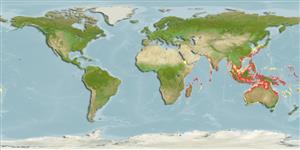
Indo-West Pacific: Ryukyu Islands south to Australia and Indonesia. Reported from Mauritius (Ref. 5503).
Lunghezza alla prima maturità / Dimensione / Peso / Età
Maturità: Lm ?, range 24 - ? cm
Max length : 100.0 cm TL maschio/sesso non determinato; (Ref. 2272); peso massimo pubblicato: 15.5 kg (Ref. 2334)
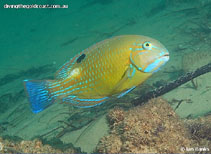
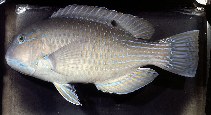
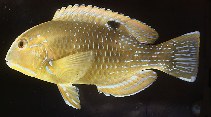
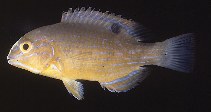
Spine dorsali (totale) : 13; Raggi dorsali molli (totale) : 7; Spine anali: 3; Raggi anali molli: 10. Large adults appear blue underwater and usually have a small black spot at the dorsal fin base. Juveniles have a large white saddle spot following the black spot (Ref. 48636). A moderately small but prominent dark spot present on body at base of last dorsal-fin spine (spot not extending onto fin membrane). Body scales each with a blue centre in life forming horizontal rows of spots on side. Second prominent anterior canine in lower jaw distinctly shorter than first in adults, directed mostly dorsally and slightly anteriorly. 3 to 5 scales on subopercle. (Ref 9823)
Body shape (shape guide): fusiform / normal; Cross section: oval.
Inhabit flat sandy or weedy areas near lagoon and seaward reefs (Ref. 9710). Solitary. Feed mainly on hard-shelled prey including crustaceans, mollusks and sea urchins. Marketed mostly fresh. In Hong Kong live fish markets (Ref. 27253).
Oviparous, distinct pairing during breeding (Ref. 205).
Randall, J.E., G.R. Allen and R.C. Steene, 1990. Fishes of the Great Barrier Reef and Coral Sea. University of Hawaii Press, Honolulu, Hawaii. 506 p. (Ref. 2334)
Stato della Lista Rossa IUCN (Ref. 130435: Version 2025-2 (Global))
Minaccia per l'uomo
Harmless
Usi umani
Pesca: commerciale; Acquacoltura: commerciale; Pesce da pesca sportiva: si; Acquario: Commerciale
Strumenti
Rapporti speciali
Scarica XML
Fonti Internet
Stime basate su modelli
Temperatura preferita (Fonte Biblio.
123201): 24.5 - 29, mean 27.9 °C (based on 478 cells).
Indice di diversità filogenetica (Fonte Biblio.
82804): PD
50 = 0.5000 [Uniqueness, from 0.5 = low to 2.0 = high].
Bayesian length-weight: a=0.00933 (0.00514 - 0.01693), b=3.09 (2.93 - 3.25), in cm total length, based on LWR estimates for this species & (Sub)family-body (Ref.
93245).
Livello trofico (Fonte Biblio.
69278): 3.4 ±0.41 se; based on food items.
Generation time: 4.2 ( na - na) years. Estimated as median ln(3)/K based on 1
growth studies.
Resilienza (Fonte Biblio.
120179): Medio, tempo minimo di raddoppiamento della popolazione 1.4 - 4.4 anni (Preliminary K or Fecundity.).
Vulnerabilità della pesca (Ref.
59153): Moderate vulnerability (39 of 100).
🛈
Nutrienti (Ref.
124155): Calcium = 29.2 [17.1, 44.4] mg/100g; Iron = 0.517 [0.303, 0.893] mg/100g; Protein = 18.9 [16.0, 21.0] %; Omega3 = 0.123 [0.083, 0.189] g/100g; Selenium = 44.2 [27.5, 74.7] μg/100g; VitaminA = 46.1 [15.6, 155.2] μg/100g; Zinc = 0.975 [0.721, 1.477] mg/100g (wet weight);