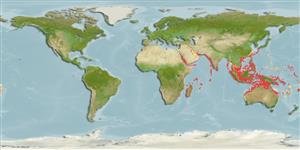
สิ่งแวดล้อม : สิ่งแวดล้อม / เขตภูมิอากาศ / ระดับความลึก / ระยะการกระจายสินค้า
นิเวศวิทยา
เกี่ยวกับทะเล,น้ำเค็ม เกี่ยวกับหินโสโครก; ไม่มีการอพยพย้ายถิ่น; ระดับความลึก 3 - 60 m (Ref. 68964), usually 3 - 60 m (Ref. 5222). Tropical; 31°N - 31°S, 30°E - 178°W (Ref. 5222)
Indo-West Pacific: Red Sea to South Africa and east to the Gilbert Islands. Probably found in all tropical islands of the Indian Ocean. Also reported from Persian Gulf (Ref. 68964). Recorded from Europa Island (MNHN 1992-0475, Ref. 33390).
ความยาวเมื่อครบกำหนดครั้งแรก / ขนาด / น้ำหนัก / อายุ
วัยเจริญพันธุ์: Lm ?, range 34 - ? cm
Max length : 60.0 cm TL เพศผู้/กระเทย; (Ref. 4787)
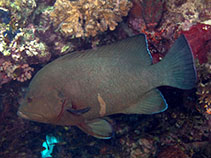
เงี่ยงครีบหลัง (รวม) : 9; ก้านครีบอ่อนที่หาง (รวม) : 17 - 18; เงี่ยงครีบก้น: 3; ก้านครีบอ่อนที่ก้น: 8 - 9. This species is distinguished by the following characters: deep and compressed body with greatest depth 2.1-2.4 in SL; dorsal head profile steep, straight, or slightly concave along snout and distinctly convex from eye to dorsal fin; longitudinal scale series 94-104; gill rakers 8-11 + 15-17; in adults the middle dorsal and anal-fin rays are elongated, giving these fins an angular profile, with the rear margin almost vertical; caudal fin truncate, 8 branched rays in upper lobe and 7 in lower lobe; pectoral fins asymmetric, 17-19 rays. Colour of body dark brown to black, occasionally with an orange cast, usually with a pale vertical bar on side of abdomen; inside of mouth, gill cavity and upper jaw membranes reddish orange; juveniles with a broad white posterior margin on caudal fin and a narrow white margin on soft dorsal fin (Ref 5222).
Body shape (shape guide): short and / or deep; Cross section: compressed.
Adults are found in coastal reefs and lagoons, often on silty habitat (Ref. 48635), in or near caves and holes in the reef. They feed mainly on small fishes (including Pempheris sp.), also on stomatopods (Pseudosquilla sp.) (Ref. 6448); and crustaceans (Ref. 37816). Preliminary data indicate that mature individuals spawn at any time of the year and mature (females?) at about 35 cm SL (Ref. 6448). Small juveniles mimic Centropyge vrolikii (Ref. 8631), and C. nox until they outgrow their model in size (Ref. 48635). Taken as part of the live reef food fish trade centered in China and In Hong Kong and are occasionally found in markets (Ref. 89707). They are caught with hook-and-line, spear, and probably in traps (Ref. 39231).
วงจรชีวิตและพฤติกรรมการผสมพันธุ์
วัยเจริญพันธุ์ | การสืบพันธุ์ | การวางไข่ | เซลสืบพันธ์ของเพศเมีย(ไข่) | ความดกของไข่ | ตัวอ่อน
Heemstra, P.C. and J.E. Randall, 1993. FAO Species Catalogue. Vol. 16. Groupers of the world (family Serranidae, subfamily Epinephelinae). An annotated and illustrated catalogue of the grouper, rockcod, hind, coral grouper and lyretail species known to date. Rome: FAO. FAO Fish. Synop. 125(16):382 p. (Ref. 5222)
สถานะบัญชีแดงของ IUCN (Ref. 130435: Version 2025-2 (Global))
ภัยคุกคามต่อมนุษย์
Harmless
การใช้ของมนุษย์
การประมง: มีการค้าเพียงเล็กน้อย; การตกปลาเป็นกีฬา: ใช่
เครื่องมือ
รายงานพิเศษ
ดาวน์โหลด XML
แหล่งที่มาจากอินเตอร์เน็ต
การประมาณค่าตามแบบจำลอง
อุณหภูมิที่ต้องการ (อ้างอิง
123201): 24.1 - 29, mean 27.9 °C (based on 2908 cells).
ดัชนีความหลากหลายทางวิวัฒนาการ (อ้างอิง
82804): PD
50 = 1.0000 [Uniqueness, from 0.5 = low to 2.0 = high].
Bayesian length-weight: a=0.01778 (0.00916 - 0.03452), b=3.02 (2.84 - 3.20), in cm total length, based on LWR estimates for this species & (Sub)family-body (Ref.
93245).
ระดับชั้นอาหาร (อ้างอิง
69278): 4.1 ±0.68 se; based on food items.
ความสามารถในการกลับคืนสู่ปกติ (อ้างอิง
120179): ขนาดกลาง, เวลาต่ำสุดที่จะทำให้ประชากรเพิ่มขึ้นเป็น 2 เท่าใช้เวลา 1.4 - 4.4 ปี (Preliminary K or Fecundity.).
ความเสี่ยงต่อการตกปลา (Ref.
59153): Moderate vulnerability (44 of 100).
🛈
ความเสี่ยงต่อสภาพภูมิอากาศ (Ref.
125649): Moderate to high vulnerability (50 of 100).
🛈
สารอาหาร (Ref.
124155): Calcium = 34.1 [19.5, 56.8] mg/100g; Iron = 0.311 [0.151, 0.637] mg/100g; Protein = 18.1 [16.2, 19.9] %; Omega3 = 0.136 [0.087, 0.211] g/100g; Selenium = 58.8 [33.8, 105.5] μg/100g; VitaminA = 91.2 [25.0, 388.5] μg/100g; Zinc = 0.488 [0.315, 2.800] mg/100g (wet weight); based on
nutrient studies.