Milieu: milieu / Klimaatzone / Diepte / verspreidingsgebied
Ecologie
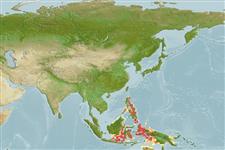
marien rifbewoner; standvastig; diepte 5 - 33 m (Ref. 5222). Tropical; 20°N - 12°S, 111°E - 149°E (Ref. 5222)
Western Pacific: Philippines, Indonesia (Sulawesi, Flores), and Papua New Guinea.
Grootte / Gewicht / Leeftijd
Maturiteit: Lm ? range ? - ? cm
Max length : 25.0 cm TL mannelijk / geslacht onbekend; (Ref. ); common length : 20.0 cm TL mannelijk / geslacht onbekend; (Ref. )
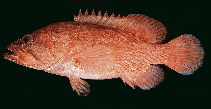
Dorsale stekels (totaal) : 9; Dorsale zachte stralen (totaal) : 14; Anale stekels: 3; Anale zachte stralen: 8. Similar to the more common Cephalopholis spiloparaea but lacks banding in the caudal fin (Ref. 48635); characterized further by reddish brown color; base of pelvic fins with indistinct dark blotch; greatest body depth 2.5-2.9 in SL; rounded caudal fin; short pelvic fins, 2.3-2.5 in head length; strongly bilobed margin of front of upper lip (Ref. 90102); head length 2.1-2.3 times in SL; rounded preopercle, posterior edge finely serrate, lower edge fleshy; very convex upper edge of operculum; maxilla extends past eye; teeth large; midlateral-body scales ctenoid (Ref. 89707).
Body shape (shape guide): fusiform / normal; Cross section: oval.
Inhabits protected or silty reef areas (Ref. 89707). Reported to be very habitat speciific, lives in very rich invertebrate habitat in the shore side of inner reefs and difficult to get shots u/w. Largest seen was about 25 cm, but usually smaller up to about 20 cm (R. Kuiter, pers. Comm. 03/2022). Maximum length given 40 cm TL (for confirmation) May undergo protogyny. Solitary (Ref 90102).
Levenscyclus en paargedrag
Maturiteit | Voortplanting | Paaien | Eieren | Fecunditeit | Larven
Heemstra, P.C. and J.E. Randall, 1993. FAO Species Catalogue. Vol. 16. Groupers of the world (family Serranidae, subfamily Epinephelinae). An annotated and illustrated catalogue of the grouper, rockcod, hind, coral grouper and lyretail species known to date. Rome: FAO. FAO Fish. Synop. 125(16):382 p. (Ref. 5222)
Status op de Rode Lijst van het IUCN (Ref. 130435: Version 2025-2 (Global))
Gevaar voor de mens
Harmless
Gebruik door de mens
Visserij: van geen belang
Tools
Speciale rapporten
Download XML
Internetbronnen
Schattingen op basis van modellen
Gewenste temperatuur (Ref.
123201): 28 - 29.1, mean 28.5 °C (based on 68 cells).
Fylogenetische diversiteitsindex (Ref.
82804): PD
50 = 0.5000 [Uniqueness, from 0.5 = low to 2.0 = high].
Bayesian length-weight: a=0.01230 (0.00576 - 0.02626), b=3.04 (2.87 - 3.21), in cm total length, based on LWR estimates for this Genus-body shape (Ref.
93245).
Trofisch niveau (Ref.
69278): 4.0 ±0.7 se; based on size and trophs of closest relatives
Weerstandsvermogen (Ref.
120179): Gemiddeld, minimale populatieverdubbelingstijd 1,4-4,4 jaar (Preliminary K or Fecundity.).
Kwetsbaarheid van de visserij (Ref.
59153): Low vulnerability (15 of 100).
🛈
Voedingsstoffen (Ref.
124155): Calcium = 47.3 [25.4, 82.5] mg/100g; Iron = 0.488 [0.263, 0.915] mg/100g; Protein = 18.7 [16.9, 20.4] %; Omega3 = 0.16 [0.10, 0.26] g/100g; Selenium = 33.2 [15.9, 57.7] μg/100g; VitaminA = 108 [37, 349] μg/100g; Zinc = 0.835 [0.594, 1.369] mg/100g (wet weight);