Environnement : milieu / zone climatique / profondeur / gamme de distribution
Écologie
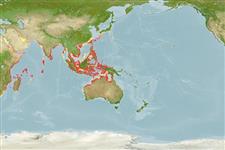
marin récifal; non migrateur; profondeur 1 - 30 m (Ref. 89707), usually 1 - 15 m (Ref. 90102). Tropical; 36°N - 34°S, 30°E - 143°E (Ref. 5222)
Indo-West Pacific: western India to Philippines, north to southern Japan (Honshu), south to northern Australia. 'Epinephelus formosus' from Madagascar (Ref. 6457), Réunion and Mauritius (Ref. 6458) are probably based on misidentifications of Cephalopholis polleni. Confused with Cephalopholis boenak.
Longueur à la première maturité / Taille / Poids / Âge
Maturité: Lm 17.0 range ? - ? cm
Max length : 34.0 cm TL mâle / non sexé; (Ref. 4787)
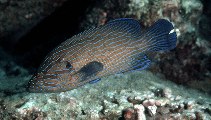
Épines dorsales (Total) : 9; Rayons mous dorsaux (Total) : 15 - 17; Épines anales: 3; Rayons mous anaux: 7 - 8. Characterized by: dark brown to yellowish brown color with narrow blue stripes; body with ctenoid scales, including abdomen; greatest depth of body 2.5-2.9 in SL; rounded caudal fin; pelvic fins, 1.6-2.0 in head length (Ref. 90102): head length 2.4-2.6 in SL; preorbital depth 3.6-4.3% SL, more than half maxilla width; convex interorbital area; rounded preopercle, finely serrate, lower edge fleshy; smooth subopercle and interopercle; maxilla naked, reaching to or just past vertical at rear edge of eye (Ref. 089707).
Body shape (shape guide): fusiform / normal; Cross section: oval.
Like C. boenak, it prefers shallow dead or silty reefs and this may account for the primarily continental distributions of these two species. Solitary (Ref 90102).
Cycle de vie et comportement reproducteur
Maturité | Reproduction | Frai | Œufs | Fécondité | Larves
Heemstra, P.C. and J.E. Randall, 1993. FAO Species Catalogue. Vol. 16. Groupers of the world (family Serranidae, subfamily Epinephelinae). An annotated and illustrated catalogue of the grouper, rockcod, hind, coral grouper and lyretail species known to date. Rome: FAO. FAO Fish. Synop. 125(16):382 p. (Ref. 5222)
Statut dans la liste rouge de l'IUCN (Ref. 130435: Version 2025-2 (Global))
Menace pour l'homme
Harmless
Utilisations par l'homme
Pêcheries: pêcheries vivrières
Outils
Articles particuliers
Télécharger en XML
Sources Internet
Estimations basées sur des modèles
Température préférée (Réf.
123201): 26.5 - 29.3, mean 28.7 °C (based on 2081 cells).
Indice de diversité phylogénétique (Réf.
82804): PD
50 = 0.5000 [Uniqueness, from 0.5 = low to 2.0 = high].
Bayesian length-weight: a=0.00955 (0.00619 - 0.01473), b=2.98 (2.86 - 3.10), in cm total length, based on LWR estimates for this species & Genus-body shape (Ref.
93245).
Niveau trophique (Réf.
69278): 4.1 ±0.7 se; based on size and trophs of closest relatives
Résilience (Réf.
120179): Milieu, temps minimum de doublement de population : 1,4 à 4,4 années (Fec = 80,208).
Vulnérabilité de la pêche (Ref.
59153): Low vulnerability (24 of 100).
🛈
Nutriments (Ref.
124155): Calcium = 54 [30, 97] mg/100g; Iron = 0.577 [0.329, 1.080] mg/100g; Protein = 18.5 [16.7, 20.2] %; Omega3 = 0.16 [0.10, 0.25] g/100g; Selenium = 29.7 [16.5, 50.7] μg/100g; VitaminA = 181 [65, 556] μg/100g; Zinc = 0.823 [0.596, 1.337] mg/100g (wet weight);