Classification / Noms
Noms communs | Synonymes | Catalog of Fishes(Genre, Espèce) | ITIS | CoL | WoRMS | Cloffa
>
Ophidiiformes (Cusk eels) >
Dinematichthyidae (Viviparous brotula)
Etymology: Eusurculus: Name from Latin and Greek 'eu' for good or real and Latin 'surculus' for grapevine tendril, refers to the functional analogy with the pseudoclaspers and the specific shape of the inner pseudoclasper; pistillum: Name from Latin 'pistillum' for pistil, refers to the sucker-disk shape of the inner pseudoclasper, this resembles the shape of a flower’s pistil; noun in apposition.
More on authors: Schwarzhans & Møller.
Environnement : milieu / zone climatique / profondeur / gamme de distribution
Écologie
marin récifal; profondeur 0 - 9 m (Ref. 76869). Tropical
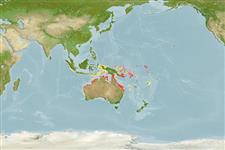
Indo-West Pacific: Australia.
Taille / Poids / Âge
Maturité: Lm ? range ? - ? cm
Max length : 4.9 cm SL mâle / non sexé; (Ref. 76869); 5.5 cm SL (female)
Description synthétique
Clés d'identification | Morphologie | Morphométrie
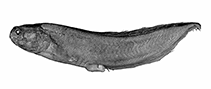
Rayons mous dorsaux (Total) : 80 - 92; Rayons mous anaux: 60 - 70; Vertèbres: 43 - 47. This species possess the following distinguishing characters: D 80-92, A 60-70, D/A 25-32, V in D 2.1-2.4; vertebrae (12) 13-14+30-34=43-47, anterior nostril situated 1/3 to 1/3.5 distance from upper lip to aggregate distance to anterior margin of eye; free pseudoclaspers 2 pairs, outer pseudoclasper wing-shaped with broad base and distally widened supporter with indistinct anterior hook (covered by ligament), inner one stalked, with narrow base and distally with large, folded sucker-disk; cheek with 4-6 scale rows on upper part, 2-3 rows on lower; otoliths with distinct ostium and cauda, with colliculi separate or partly fused, otolith length to height is 2.2-2.4, ostial colliculum length to caudal colliculum length is 3-4 (Ref. 76869).
Collected from sublittoral area, with rocks, mud, corals and brown algae. It appears to be most common in reef environments, often on outer reefs, and avoid inshore and back reef areas (Ref. 76869).
Cycle de vie et comportement reproducteur
Maturité | Reproduction | Frai | Œufs | Fécondité | Larves
Schwarzhans, W. and P.R. Møller, 2007. Review of the Dinematichthyini (Teleostei: Bythitidae) of the Indo-west Pacific. Part III. Beaglichthys, Brosmolus, Monothrix and eight new genera with description of 20 new species. The Beagle, Records of the Museums and Art Galleries of the Northern Territory 23:29-110. (Ref. 76869)
Statut dans la liste rouge de l'IUCN (Ref. 130435: Version 2025-2 (Global))
Utilisations par l'homme
Outils
Articles particuliers
Télécharger en XML
Sources Internet
Estimations basées sur des modèles
Température préférée (Réf.
123201): 24 - 29.4, mean 27.5 °C (based on 760 cells).
Indice de diversité phylogénétique (Réf.
82804): PD
50 = 0.6250 [Uniqueness, from 0.5 = low to 2.0 = high].
Bayesian length-weight: a=0.00389 (0.00180 - 0.00842), b=3.12 (2.94 - 3.30), in cm total length, based on all LWR estimates for this body shape (Ref.
93245).
Niveau trophique (Réf.
69278): 3.3 ±0.5 se; based on size and trophs of closest relatives
Vulnérabilité de la pêche (Ref.
59153): Low vulnerability (10 of 100).
🛈