>
Ophidiiformes (Cusk eels) >
Dinematichthyidae (Viviparous brotula)
Etymology: Ungusurculus: Name from Latin words 'ungulus' (= claw) and 'surculus' (= grapevine tendril), refers to the functional analogy with the pseudoclaspers and the specific shape of the inner pseudoclasper; sundaensis: Named for the Sunda Archipelago of Indonesia,.
More on authors: Schwarzhans & Møller.
Ambiente: milieu / zona climatica / distribuzione batimetrica / gamma di distribuzione
Ecologia
marino associati a barriera corallina; distribuzione batimetrica 0 - 8 m (Ref. 90102). Tropical
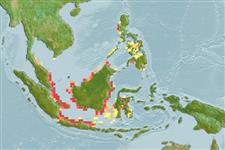
Western Pacific: Indonesia.
Dimensione / Peso / Età
Maturità: Lm ? range ? - ? cm
Max length : 5.4 cm SL maschio/sesso non determinato; (Ref. 76869)
Breve descrizione
Chiavi di identificazione | Morfologia | Morfometria
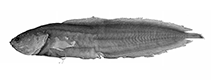
Raggi dorsali molli (totale) : 79 - 86; Raggi anali molli: 60 - 64; Vertebre: 42 - 43. This species is distinguished by the following characters: D 79-86, A 60-64, D/A 26, V in D 2.2-2.3; vertebrae 12+30-31=42-43; anterior nostril located 1/4 distance from upper lip to aggregate distance to anterior margin of eye; free pseudoclaspers 2 pairs, the outer pseudoclasper is wing-shaped with broad base and distally widened supporter with anterior hook, prominent knob on inner face of outer pseudoclasper fitting into opening of inner pseudoclasper, the inner one is long, very massive, stalked with narrow base, distally with claw-like, outwardly directed strong spines, inner and outer pseudoclasper matching together in lock/key mode; cheeks with 6 scale rows on upper part and 4 rows on lower part; no upper preopercular pore; otolith elongate, its length to height is 2.3-2.4, with pointed anterior and posterior tips, symmetrical pre- and postdorsal angles, the section in between straight, short sulcus with fused colliculi, its centre anterior of centre of otolith, inclined about 5°, otolith length to sulcus length is 2.4-2.5 (Ref. 76869).
Body shape (shape guide): elongated; Cross section: compressed.
Cryptic and solitary, inhabits reef crevices in about 0-8 m (Ref 90102).
Ciclo vitale e comportamento di accoppiamento
Maturità | Riproduzione | Deposizione | Uova | Fecondità | Larve
Schwarzhans, W. and P.R. Møller, 2007. Review of the Dinematichthyini (Teleostei: Bythitidae) of the Indo-west Pacific. Part III. Beaglichthys, Brosmolus, Monothrix and eight new genera with description of 20 new species. The Beagle, Records of the Museums and Art Galleries of the Northern Territory 23:29-110. (Ref. 76869)
Stato della Lista Rossa IUCN (Ref. 130435: Version 2025-2 (Global))
Usi umani
Pesca: di nessun interesse
Strumenti
Rapporti speciali
Scarica XML
Fonti Internet
Stime basate su modelli
Temperatura preferita (Fonte Biblio.
123201): 28.8 - 29.2, mean 29 °C (based on 265 cells).
Indice di diversità filogenetica (Fonte Biblio.
82804): PD
50 = 0.5156 [Uniqueness, from 0.5 = low to 2.0 = high].
Bayesian length-weight: a=0.00389 (0.00180 - 0.00842), b=3.12 (2.94 - 3.30), in cm total length, based on all LWR estimates for this body shape (Ref.
93245).
Livello trofico (Fonte Biblio.
69278): 3.2 ±0.5 se; based on size and trophs of closest relatives
Vulnerabilità della pesca (Ref.
59153): Low vulnerability (10 of 100).
🛈