>
Scombriformes (Mackerels) >
Trichiuridae (Cutlassfishes) > Lepidopodinae
Etymology: Lepidopus: Greek, lepis = scale + Greek, pous = foot (Ref. 45335).
Environnement : milieu / zone climatique / profondeur / gamme de distribution
Écologie
marin benthopélagique; océanodrome (Ref. 51243); profondeur 42 - 620 m (Ref. 56504), usually 100 - 300 m (Ref. 6181). Deep-water; 64°N - 49°S, 29°W - 176°W (Ref. 6181)
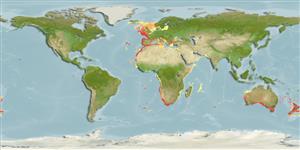
Eastern Atlantic: France and western Mediterranean to Senegal, including Azores, Madeira, the Canary Islands and offshore seamounts; Cape Fria, Namibia to Agulhas Bank, South Africa including northern Walvis Ridge. Southern Indian Ocean: seamounts 30 to 35°S. Southwest Pacific: Australia (New South Wales to southern West Australia) and New Zealand. Southeast Pacific: Peru. A doubtful record from Cape San Lucas, Mexico.
Longueur à la première maturité / Taille / Poids / Âge
Maturité: Lm 111.0, range 92 - ? cm
Max length : 210 cm TL mâle / non sexé; (Ref. 36731); common length : 117 cm SL mâle / non sexé; (Ref. 6181); poids max. publié: 8.0 kg (Ref. 6181); âge max. reporté: 8 années (Ref. 117131)
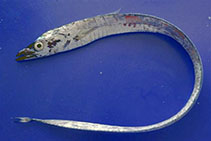
Rayons mous dorsaux (Total) : 98 - 110; Épines anales: 2; Rayons mous anaux: 59 - 66; Vertèbres: 105 - 114. Second anal-fin spine plate-like. Pyloric caeca 20 - 29. Body uniformly silvery (Ref. 6181). Pelvic fin very small (Ref. 35388).
Body shape (shape guide): eel-like; Cross section: compressed.
Occur on continental shelf, along its edge and upper slope down to 400 m (600 m in Australia), usually over sandy and muddy bottoms from 100 to 250 m (over 300 m in Australia). Depth range from 333-620 m in the eastern Ionian Sea (Ref. 56504). Migrate into midwater at night. Form schools; occasionally found inshore in upwelling of deep water when it appears at surface. Feed on crustaceans, small squid and fish (Ref. 6768). Eggs and larvae are pelagic (Ref. 6768).
Nakamura, I. and N.V. Parin, 1993. FAO Species Catalogue. Vol. 15. Snake mackerels and cutlassfishes of the world (families Gempylidae and Trichiuridae). An annotated and illustrated catalogue of the snake mackerels, snoeks, escolars, gemfishes, sackfishes, domine, oilfish, cutlassfishes,. scabbardfishes, hairtails, and frostfishes known to date. FAO Fish. Synop. 125(15):136 p. (Ref. 6181)
Statut dans la liste rouge de l'IUCN (Ref. 130435: Version 2025-2 (Global))
Menace pour l'homme
Harmless
Utilisations par l'homme
Pêcheries: hautement commercial; pêche sportive: oui
Outils
Articles particuliers
Télécharger en XML
Sources Internet
Estimations basées sur des modèles
Température préférée (Réf.
123201): 9.8 - 16, mean 12.1 °C (based on 330 cells).
Indice de diversité phylogénétique (Réf.
82804): PD
50 = 0.5156 [Uniqueness, from 0.5 = low to 2.0 = high].
Bayesian length-weight: a=0.00042 (0.00033 - 0.00052), b=3.11 (3.04 - 3.18), in cm total length, based on LWR estimates for this species (Ref.
93245).
Niveau trophique (Réf.
69278): 3.8 ±0.3 se; based on diet studies.
Résilience (Réf.
120179): Milieu, temps minimum de doublement de population : 1,4 à 4,4 années (K=0.14-0.38; tmax=5-8).
Prior r = 0.41, 95% CL = 0.27 - 0.61, Based on 4 data-limited stock assessments.
Vulnérabilité de la pêche (Ref.
59153): Moderate to high vulnerability (53 of 100).
🛈
Vulnérabilité climatique (Ref.
125649): Moderate vulnerability (38 of 100).
🛈
Nutriments (Ref.
124155): Calcium = 12.7 [5.3, 26.3] mg/100g; Iron = 0.278 [0.126, 0.619] mg/100g; Protein = 17.3 [15.6, 19.0] %; Omega3 = 0.219 [0.095, 0.529] g/100g; Selenium = 34.6 [12.2, 93.0] μg/100g; VitaminA = 4.17 [0.63, 22.13] μg/100g; Zinc = 0.279 [0.173, 0.476] mg/100g (wet weight); based on
nutrient studies.