Umwelt: Milieu / Klimazone / Tiefenbereich / Verbreitungsgebiet
Ökologie
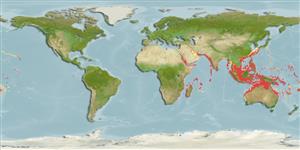
seewasser riff-verbunden; standorttreu; tiefenbereich 2 - 150 m (Ref. 9710). Tropical; 35°N - 32°S, 30°E - 156°W (Ref. 5222)
Indo-Pacific: Red Sea to Durban, South Africa and eastward to the Line Islands; including most islands in the Indian and west-central Pacific oceans. Absent from Persian Gulf and Gulf of Oman. Misidentified as Cephalopholis cyanostigma from Reunion (Ref. 6453).
Länge bei der ersten Reifung / Größe / Gewicht / Alter
Geschlechtsreife: Lm ?, range 26 - ? cm
Max length : 50.0 cm TL Männchen/unbestimmt; (Ref. 90102)
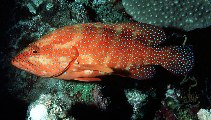
Rückenflossenstacheln (insgesamt) : 9; Rückenflossenweichstrahlen (insgesamt) : 14 - 15; Afterflossenstacheln: 3; Afterflossenweichstrahlen: 8 - 9. Color orange-red to reddish brown, usually dark posteriorly with numerous bright blue spots which are smaller than the pupil and often faintly dark-edged on head, body and median fins; distal margin of caudal fin and soft portions of dorsal and anal fins usually with a narrow blue margin and blackish submarginal line; orange-yellow pectoral fins, on some only distally; orange-red pelvic fins; it is capable of a disruptive color pattern of irregular oblique olivaceous bars; juveniles may be yellow with scattered faint blue spots. D IX, 14-16; A III, 8-9 (rarely 8); pectoral 17-18 (often 18); scales on lateral line 47-55; scales on longitudinal series 94-114; snout anterior to nostrils no scales; partially scaled maxilla; abdomen with cycloid scales; gill rakers 7-9 + 13-15; depth of body 2.65-3.05 in SL; length of head 2.4-2.65 in SL; the maxilla extends to or posterior to rear of the orbit; smooth ventral margin of preopercle; 5th - 8th dorsal spines longest , 3.0-3.6 in head; pectoral fins 1.45-1.75 in head; pelvic fins do not reach the anus, 1.9-2.3 in head (Ref. 4787).
Body shape (shape guide): fusiform / normal; Cross section: compressed.
Inhabit clear waters of coral reefs; more often found in exposed rather than protected reef areas (Ref. 5213). Feed on fishes (80%, mainly Pseudanthias squamipinnis) and crustaceans. Form haremic groups comprising of a dominant male and 2 to 12 females. These groups occupy territories of up to 475 sq m subdivided into secondary territories and defended by a single female (Ref. 6480). Generally common (Ref. 9710).
Lebenszyklus und Paarungsverhalten
Geschlechtsreife | Fortpflanzung | Ablaichen | Eier | Fruchtbarkeit | Larven
Heemstra, P.C. and J.E. Randall, 1993. FAO Species Catalogue. Vol. 16. Groupers of the world (family Serranidae, subfamily Epinephelinae). An annotated and illustrated catalogue of the grouper, rockcod, hind, coral grouper and lyretail species known to date. Rome: FAO. FAO Fish. Synop. 125(16):382 p. (Ref. 5222)
IUCN Rote Liste Status (Ref. 130435: Version 2025-2 (Global))
Bedrohung für Menschen
Harmless
Nutzung durch Menschen
Fischereien: kommerziell; Sportfisch: ja; Aquarium: Kommerziell
Tools
Zusatzinformationen
Download XML
Internet Quellen
Schätzungen auf der Grundlage von Modellen
Bevorzugte Temperatur (Ref.
123201): 23.7 - 29, mean 27.8 °C (based on 2104 cells).
Phylogenetischer Diversitätsindex (Ref.
82804): PD
50 = 0.5000 [Uniqueness, from 0.5 = low to 2.0 = high].
Bayesian length-weight: a=0.01148 (0.00965 - 0.01366), b=3.04 (3.01 - 3.07), in cm total length, based on LWR estimates for this species (Ref.
93245).
Trophische Ebene (Ref.
69278): 4.3 ±0.5 se; based on diet studies.
Generation time: 11.0 ( na - na) years. Estimated as median ln(3)/K based on 2
growth studies.
Widerstandsfähigkeit (Ref.
120179): niedrig, Verdopplung der Population dauert 4,5 - 14 Jahre. (tmax=30; K=0.101).
Anfälligkeit der Fischerei (Ref.
59153): High to very high vulnerability (65 of 100).
🛈
Klimaanfälligkeit (Ref.
125649): High vulnerability (57 of 100).
🛈
Nährstoffe (Ref.
124155): Calcium = 33.1 [19.0, 56.1] mg/100g; Iron = 0.462 [0.261, 0.873] mg/100g; Protein = 18.3 [16.5, 20.0] %; Omega3 = 0.165 [0.105, 0.264] g/100g; Selenium = 43.7 [24.0, 79.0] μg/100g; VitaminA = 189 [61, 665] μg/100g; Zinc = 0.783 [0.546, 1.236] mg/100g (wet weight); based on
nutrient studies.