สิ่งแวดล้อม : สิ่งแวดล้อม / เขตภูมิอากาศ / ระดับความลึก / ระยะการกระจายสินค้า
นิเวศวิทยา
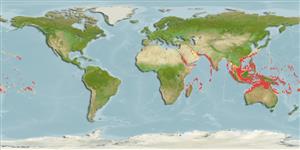
เกี่ยวกับทะเล,น้ำเค็ม เกี่ยวกับหินโสโครก; ไม่มีการอพยพย้ายถิ่น; ระดับความลึก 0 - 150 m (Ref. 9710). Tropical; 34°N - 23°S, 31°E - 138°W (Ref. 5222)
Indo-Pacific: Red Sea to South Africa and eastward to French Polynesia. Reported from the Arafura Sea (Ref. 9819). Reports by Heemstra & Randall (1984, Ref. 3153) from the Gulf of Oman, Pakistan, India, and Sri Lanka are unsubstantiated. Absent from the Persian Gulf and is not yet known from Lakshadweep Islands.
ขนาด / น้ำหนัก / อายุ
วัยเจริญพันธุ์: Lm ? range ? - ? cm
Max length : 50.0 cm TL เพศผู้/กระเทย; (Ref. 11441); น้ำหนักสูงสุดที่มีการรายงาน: 7.0 kg (Ref. 30874)
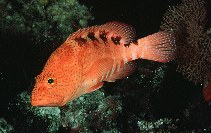
เงี่ยงครีบหลัง (รวม) : 9; ก้านครีบอ่อนที่หาง (รวม) : 14 - 16; เงี่ยงครีบก้น: 3; ก้านครีบอ่อนที่ก้น: 9. This species is distinguished by the following characters: greatest body depth 2.5-3.0 times in standard length (for specimens 13-39 cm SL); head length 2.3-2.5 times in SL; longitudinal scale series 95-108; ctenoid scales on body, including abdomen; caudal fin rounded; pelvic fins not reaching or just about the anus, 1.9-2.3 in HL. Colour of body orange-red, with small blue spots sparsely scattered but more densely on head and median fins; head also with elongated blue spots and lines; body with 4 dark bars (sometimes very faint) merging dorsally with blackish blotches at base of dorsal fin and extending onto the fin; 2 similar but smaller dark bar/blotches on caudal peduncle (Ref. 39231, 90102).
Body shape (shape guide): fusiform / normal; Cross section: oval.
Adults are found in rich coastal to outer reefs, usually along deep walls with caves, rich with invertebrate growth such as large sponges or soft corals (Ref. 48635). They occur singly or in small groups (Ref. 90102). A secretive species which are active nocturnally in shallow water and diurnally in deeper water (Ref. 5222). They are often seen with the cleaner shrimp Periclimenes elegans (Ref. 37816). Adults feed mainly on fishes (Ref. 5222) and reach sexual maturity at 25 cm SL (Ref. 89707). Probably of commercial interest to certain local fisheries. Are caught with hook-and-line, traps, and spear (Ref. 39231). Minimum depth reported taken from Ref. 128797.
วงจรชีวิตและพฤติกรรมการผสมพันธุ์
วัยเจริญพันธุ์ | การสืบพันธุ์ | การวางไข่ | เซลสืบพันธ์ของเพศเมีย(ไข่) | ความดกของไข่ | ตัวอ่อน
Heemstra, P.C. and J.E. Randall, 1993. FAO Species Catalogue. Vol. 16. Groupers of the world (family Serranidae, subfamily Epinephelinae). An annotated and illustrated catalogue of the grouper, rockcod, hind, coral grouper and lyretail species known to date. Rome: FAO. FAO Fish. Synop. 125(16):382 p. (Ref. 5222)
สถานะบัญชีแดงของ IUCN (Ref. 130435: Version 2025-2 (Global))
ภัยคุกคามต่อมนุษย์
Harmless
การใช้ของมนุษย์
การประมง: การประมงยังชีพ; การตกปลาเป็นกีฬา: ใช่
เครื่องมือ
รายงานพิเศษ
ดาวน์โหลด XML
แหล่งที่มาจากอินเตอร์เน็ต
การประมาณค่าตามแบบจำลอง
อุณหภูมิที่ต้องการ (อ้างอิง
123201): 23.7 - 28.5, mean 27.2 °C (based on 881 cells).
ดัชนีความหลากหลายทางวิวัฒนาการ (อ้างอิง
82804): PD
50 = 0.5000 [Uniqueness, from 0.5 = low to 2.0 = high].
Bayesian length-weight: a=0.01230 (0.00576 - 0.02626), b=3.04 (2.87 - 3.21), in cm total length, based on LWR estimates for this Genus-body shape (Ref.
93245).
ระดับชั้นอาหาร (อ้างอิง
69278): 4.0 ±0.66 se; based on food items.
ความสามารถในการกลับคืนสู่ปกติ (อ้างอิง
120179): ขนาดกลาง, เวลาต่ำสุดที่จะทำให้ประชากรเพิ่มขึ้นเป็น 2 เท่าใช้เวลา 1.4 - 4.4 ปี (Preliminary K or Fecundity.).
ความเสี่ยงต่อการตกปลา (Ref.
59153): Moderate vulnerability (40 of 100).
🛈
สารอาหาร (Ref.
124155): Calcium = 42.7 [25.3, 74.7] mg/100g; Iron = 0.56 [0.32, 1.08] mg/100g; Protein = 18.5 [16.7, 20.1] %; Omega3 = 0.175 [0.110, 0.278] g/100g; Selenium = 48 [26, 84] μg/100g; VitaminA = 116 [44, 354] μg/100g; Zinc = 0.721 [0.509, 1.162] mg/100g (wet weight);