Klassifizierung / Names
Namen | Synonyme | Catalog of Fishes(Gattung, Arten) | ITIS | CoL | WoRMS | Cloffa
>
Acanthuriformes (Surgeonfishes) >
Lobotidae (Tripletails)
Etymology: Hapalogenys: Greek, hapalos = soft * Greek, geny, -yos = face (Ref. 45335); dampieriensis: The specific name refers to the Dampierian Province (named for the explorer William Dampier), a biogeographic region extending from approximately Geraldton in Western Australia across northern Australia to Cape York, the distribution of this species.
Umwelt: Milieu / Klimazone / Tiefenbereich / Verbreitungsgebiet
Ökologie
seewasser benthopelagisch; tiefenbereich 87 - 230 m (Ref. 76777). Tropical
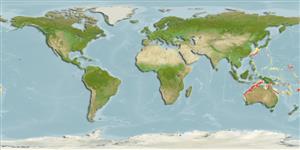
Indo-west Pacific: north-western Australia.
Größe / Gewicht / Alter
Geschlechtsreife: Lm ? range ? - ? cm
Max length : 30.0 cm SL Männchen/unbestimmt; (Ref. 76777)
Kurzbeschreibung
Bestimmungsschlüssel | Morphologie | Morphometrie
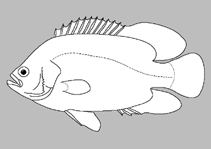
Rückenflossenstacheln (insgesamt) : 11; Rückenflossenweichstrahlen (insgesamt) : 13 - 14; Afterflossenstacheln: 3; Afterflossenweichstrahlen: 8 - 9. Distinguished from other congeners by having the following combination of characters: lower lip fleshy with dense cluster of very short papillae anteriorly, scaly posteriorly (on posterior abdominal part of angular of lower jaws); presence of 10 unobstructed pores on and behind chin (posteriormost 2 sometimes slit-like); maxilla without scales; presence of 4 narrow longitudinal dark stripes (2nd and 3rd stripes most distinct, 2nd from nape to base of mid dorsal-fin soft rays, 3rd from eye to last dorsal-fin ray base) in specimens less than about 10 cm SL, thereafter 2nd and 3rd stripes visible only, remainder and 3rd stripes not present in specimens less than about 20 cm SL, their width below base of 5th and 6th dorsal-fin spines clearly narrower than pupil diameter in 6.5-15.8 cm SL); pored lateral-line scales 41-45; soft rayed portions of dorsal and anal fins somewhat truncated posteriorly and slightly angulated posteriorly, respectively; pelvic-fin tip extending beyond anus but clearly not reaching to base of 1st anal-fin spine when depressed; procumbent spine-like process (tip of 1st pterygiophore) apparent at origin of dorsal-fin but covered by predorsal scales (Ref. 76777).
Body shape (shape guide): short and / or deep.
The habitat is likely to be dominated by a muddy rocky bottom (Ref. 76777).
Lebenszyklus und Paarungsverhalten
Geschlechtsreife | Fortpflanzung | Ablaichen | Eier | Fruchtbarkeit | Larven
Iwatsuki, Y. and B.C. Russell, 2006. Revision of the genus Hapalogenys (Teleostei: Perciformes) with two new species from the Indo-West Pacific. Mem. Mus. Victoria 63(1):29-46. (Ref. 76777)
IUCN Rote Liste Status (Ref. 130435: Version 2025-2 (Global))
Nutzung durch Menschen
Fischereien: bycatch
Tools
Zusatzinformationen
Download XML
Internet Quellen
Schätzungen auf der Grundlage von Modellen
Bevorzugte Temperatur (Ref.
123201): 19.3 - 26.5, mean 22.5 °C (based on 65 cells).
Phylogenetischer Diversitätsindex (Ref.
82804): PD
50 = 0.5039 [Uniqueness, from 0.5 = low to 2.0 = high].
Bayesian length-weight: a=0.01905 (0.00861 - 0.04217), b=3.01 (2.81 - 3.21), in cm total length, based on LWR estimates for this (Sub)family-body shape (Ref.
93245).
Trophische Ebene (Ref.
69278): 3.9 ±0.6 se; based on size and trophs of closest relatives
Widerstandsfähigkeit (Ref.
120179): hoch, Verdopplung der Population dauert weniger als 15 Monate. (Preliminary K or Fecundity.).
Anfälligkeit der Fischerei (Ref.
59153): Low to moderate vulnerability (27 of 100).
🛈