Taxonomic Remarks
Indian Ocean species refers to C. nigripinnis; reference needed (N.Bailly pers.comm., 02/2019).
Ambiente: milieu / zona climatica / distribuzione batimetrica / gamma di distribuzione
Ecologia
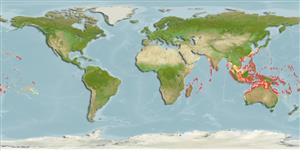
marino associati a barriera corallina; distribuzione batimetrica 0 - 60 m (Ref. 5222), usually 3 - 15 m (Ref. 9710). Tropical; 34°N - 30°S, 33°E - 131°W (Ref. 5222)
Pacific Ocean: eastward to French Polynesia and the Pitcairn Islands, and to Christmas Isalnd in the Indian Ocean
Lunghezza alla prima maturità / Dimensione / Peso / Età
Maturità: Lm ?, range 17 - ? cm
Max length : 28.0 cm TL maschio/sesso non determinato; (Ref. 5222)
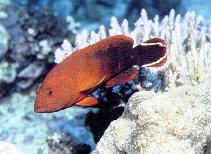
Spine dorsali (totale) : 9; Raggi dorsali molli (totale) : 14 - 16; Spine anali: 3; Raggi anali molli: 8 - 9. This species is distinguished by the following characteristics: greatest body depth 2.7-3.1 in standard length; body scales ctenoid except cycloid scales ventrally on abdomen; rounded caudal fin; pelvic fins usually not reaching the anus, 1.8-2.2 in head length Colour of body reddish brown anteriorly, dark brown posteriorly; caudal fin with 2 white to bluish white bands that converge posteriorly (Ref. 90102).
Body shape (shape guide): fusiform / normal; Cross section: compressed.
Adults inhabit clear, shallow waters of outer reef areas, in lagoons, back-reef areas, and on the reef-top. As solitary individuals (Ref. 90102), they prefer healthy coral reef in shallow areas, and are therefore greatly affected by reef degradation (Ref. 89707). They feed on small fishes (68%) and crustaceans. Because of its small size, the darkfin hind is not of much interest as a food fish (except perhaps to subsistence fisheries), but it does well in an aquarium and may find a market as an aquarium fish. They are caught with hook-and-line, gill nets, and in traps (Ref. 39231). Minimum depth reported taken from Ref. 128797.
Ciclo vitale e comportamento di accoppiamento
Maturità | Riproduzione | Deposizione | Uova | Fecondità | Larve
Protogyny is unconfirmed for this species (Ref. 103751).
Heemstra, P.C. and J.E. Randall, 1993. FAO Species Catalogue. Vol. 16. Groupers of the world (family Serranidae, subfamily Epinephelinae). An annotated and illustrated catalogue of the grouper, rockcod, hind, coral grouper and lyretail species known to date. Rome: FAO. FAO Fish. Synop. 125(16):382 p. (Ref. 5222)
Stato della Lista Rossa IUCN (Ref. 130435: Version 2025-2 (Global))
Minaccia per l'uomo
Harmless
Usi umani
Pesca: pesca di sussistenza; Acquario: Potenziale
Strumenti
Rapporti speciali
Scarica XML
Fonti Internet
Stime basate su modelli
Temperatura preferita (Fonte Biblio.
123201): 25.2 - 29.3, mean 28.4 °C (based on 3224 cells).
Indice di diversità filogenetica (Fonte Biblio.
82804): PD
50 = 0.5000 [Uniqueness, from 0.5 = low to 2.0 = high].
Bayesian length-weight: a=0.01202 (0.00781 - 0.01852), b=3.05 (2.93 - 3.17), in cm total length, based on LWR estimates for this species & Genus-body shape (Ref.
93245).
Livello trofico (Fonte Biblio.
69278): 4.0 ±0.69 se; based on food items.
Generation time: 0.8 ( na - na) years. Estimated as median ln(3)/K based on 1
growth studies.
Resilienza (Fonte Biblio.
120179): Alto, tempo minimo di raddoppiamento della popolazione meno di 15 mesi (Preliminary K or Fecundity.).
Vulnerabilità della pesca (Ref.
59153): Low vulnerability (14 of 100).
🛈
Nutrienti (Ref.
124155): Calcium = 84.7 [50.2, 180.6] mg/100g; Iron = 0.894 [0.477, 1.805] mg/100g; Protein = 18.6 [16.7, 20.3] %; Omega3 = 0.174 [0.098, 0.316] g/100g; Selenium = 50.5 [24.1, 100.4] μg/100g; VitaminA = 80.9 [29.1, 256.2] μg/100g; Zinc = 0.998 [0.666, 1.731] mg/100g (wet weight);