Classificatie / Namen
Lokale namen | Synoniemen | Catalog of Fishes(Genus, Soort(en)) | ITIS | CoL | WoRMS | Cloffa
>
Perciformes/Serranoidei (Groupers) >
Anthiadidae (Fairy basslets or Streamer basses)
Etymology: Odontanthias: Greek, odous = teeth + Greek, anthis = a fish, Sparus aurata (Ref. 45335); wassi: Named for Richard C. Wass, who obtained the holotype.
Eponymy: Dr Richard Charles Wass (d: 1942) was the fisheries officer of the US Fish & Wildlife Service who collected many fishes in American Samoa in the 1970s and early 1980s. [...] (Ref. 128868), visit book page.
More on authors: Randall & Heemstra.
Milieu: milieu / Klimaatzone / Diepte / verspreidingsgebied
Ecologie
marien benthopelagisch; diepte ? - 100 m (Ref. 57080). Tropical
Central Pacific: American Samoa.
Grootte / Gewicht / Leeftijd
Maturiteit: Lm ? range ? - ? cm
Max length : 12.3 cm SL (female)
Korte beschrijving
Determinatiesleutels | Morfologie | Morfometrie
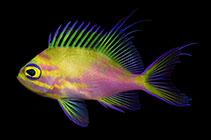
Dorsale stekels (totaal) : 10; Dorsale zachte stralen (totaal) : 16; Anale stekels: 3; Anale zachte stralen: 7; Wervels: 26. This species is distinguished by the following characters: D X,16; A III, 7; pectoral rays 17; lateral-line scales 42; gill rakers 14 + 31; body depth 2.35 in SL; head length (HL) 2.75 in SL; large eye, orbit diameter 3.15 in HL; at angle of preopercle a spine extending about half distance to margin of subopercle; arrowhead-shaped vomerine tooth patch; mesopterygoids with a patch of villiform teeth; dorsally on snout are small scales nearly reaching base of upper lip; anteriorly mandible scaled nearly to second mandibular pore; elongate third dorsal spine, 1.55 in HL; dorsal fin with no rays produced as filaments; third anal spine slightly longer than second, 1.95 HL; deeply emarginate caudal fin, the lobes tapering little and not pointed, fin length 2.55 in SL; pectoral fins 1.15 in HL, 3.2 in SL; pelvic fins are reaching base of third anal spine, 3.05 in SL; body color when fresh deep pink dorsally, paler ventrally, with a large yellow area on body above pectoral fin except large faint dusky patches below dorsal fin; head crossed by 4 faint yellow stripes; dorsal fin is mainly yellow basally, pink distally; caudal fin pink, a broad yellow band in each lobe, confluent basally in fin (Ref. 57080).
Body shape (shape guide): fusiform / normal.
Levenscyclus en paargedrag
Maturiteit | Voortplanting | Paaien | Eieren | Fecunditeit | Larven
Randall, J.E. and P.C. Heemstra, 2006. Review of the Indo-Pacific fishes of the genus Odontanthias (Serranidae: Anthiinae), with descriptions of two new species and a related genus. Indo-Pac. Fish. (38):32 p. (Ref. 57080)
Status op de Rode Lijst van het IUCN (Ref. 130435: Version 2025-2 (Global))
Gebruik door de mens
Tools
Speciale rapporten
Download XML
Internetbronnen
Schattingen op basis van modellen
Fylogenetische diversiteitsindex (Ref.
82804): PD
50 = 0.5000 [Uniqueness, from 0.5 = low to 2.0 = high].
Bayesian length-weight: a=0.01413 (0.00621 - 0.03212), b=3.00 (2.81 - 3.19), in cm total length, based on LWR estimates for this (Sub)family-body shape (Ref.
93245).
Trofisch niveau (Ref.
69278): 3.3 ±0.4 se; based on size and trophs of closest relatives
Weerstandsvermogen (Ref.
120179): Hoog, minimale populatieverdubbelingstijd minder dan 15 maanden (Preliminary K or Fecundity.).
Kwetsbaarheid van de visserij (Ref.
59153): Low vulnerability (10 of 100).
🛈