>
Blenniiformes (Blennies) >
Tripterygiidae (Triplefin blennies) > Tripterygiinae
Etymology: Enneapterygius: Greek, ennea = nine times + Greek, pterygion = little fin (Ref. 45335); senoui: Named for Dr. Hiroshi Senou, collector of the holotype.
Eponymy: Dr Hiroshi Senou of the Division of Fishes, Kanagawa Prefectural Museum of Natural History, has been a leader in the drive to find more about the tropical reef fishes occurring in southern Japan and the adjacent Ryukyu Archipelago. [...] (Ref. 128868), visit book page.
Entorno: milieu / zona climática / rango de profundidad / gama de distribución
Ecología
marino bentopelágico; rango de profundidad 3 - 11 m (Ref. 78435), usually 3 - 6 m (Ref. 78435). Temperate
Distribución
Territorios | Áreas FAO | Ecosistemas | Ocurrencias, apariciones | Mapa de puntos | Introducciones | Faunafri
Northwestern Pacific: Japan.
Tamaño / Peso / Edad
Madurez: Lm ? range ? - ? cm
Max length : 2.7 cm SL macho / no sexado; (Ref. 78435); 2.7 cm SL (female)
Descripción breve
Claves de identificación | Morfología | Morfometría
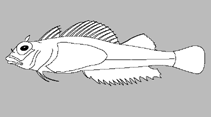
Espinas dorsales (total) : 17 - 18; Radios blandos dorsales (total) : 9 - 11; Espinas anales: 1; Radios blandos anales: 18 - 20. This small species is distinct with the following set characters: D1 III, D2 XIV-XV (mode XV) , D3 9-11; A I, 18-20; pectoral 14-17; pored lateral line scales 20-2 ; notched lateral line scales 17-19; scale rows above first pored lateral line scale 2-3; scale rows above last pored lateral line scale 2-2.5; scale rows below first notched lateral line scale 3-4; mandibular pore formula 4-5 + 1-2 + 4-5; nasal tentacle unbranched flat and broad distally; height of first dorsal fin less than that of second; caudal peduncle with a broad vertical white band behind third dorsal
fin, both sexes with blue lines or spots on head; anterior two-thirds of body and fins are black, and posterior tip of anal fin yellow in melanistic males; head and body with reddish spots, and anal fin yellow basally in pale males and females (Ref. 78435).
Body shape (shape guide): elongated; Cross section: compressed.
Commonly found in 3-6 m, but are not observed in tidal pools or deeper than 11 m. Adults are usually found in areas with strong regular surges generated by wave swells, but not in areas with strong unidirectional currents or breaking waves. Individuals often inhabited inclined, usually near vertical, flat surfaces of large rocks, being found near the substrate. Spawning in Hachijo-jima Island was observed early morning until 8:00 am, from the end of March to July (Ref. 78435). Eggs are hemispherical and covered with numerous sticky threads that anchor them in the algae on the nesting sites (Ref. 240). Larvae are planktonic which occur primarily in shallow, nearshore waters (Ref. 94114).
Ciclo vital y comportamiento de apareamiento
Madurez | Reproducción | Puesta | Huevos | Fecundidad | Larva
Motomura, H., S. Harazaki and G.S. Hardy, 2005. A new species of triplefin (Perciformes: Tripterygiidae), Enneapterygius senoui, from Japan with a discussion of its in situ colour pattern. aqua, J. Ichthyol. Aquat. Biol. 10(1):5-14. (Ref. 78435)
Situación en la Lista Roja de la UICN (Ref. 130435: Version 2025-2 (Global))
Amenaza para el ser humano
Harmless
Usos humanos
Pesquerías: sin interés
Herramientas
Informes especiales
Descargar XML
Fuentes de Internet
Estimaciones basadas en modelos
Índice de diversidad filogenética (Referencia
82804): PD
50 = 0.5000 [Uniqueness, from 0.5 = low to 2.0 = high].
Bayesian length-weight: a=0.00617 (0.00290 - 0.01310), b=3.04 (2.86 - 3.22), in cm total length, based on LWR estimates for this (Sub)family-body shape (Ref.
93245).
Nivel trófico (Referencia
69278): 3.1 ±0.3 se; based on size and trophs of closest relatives
Resiliencia (Referencia
120179): Alto, población duplicada en un tiempo mínimo inferior a 15 meses (Preliminary K or Fecundity.).
Vulnerabilidad pesquera (Ref.
59153): Low vulnerability (10 of 100).
🛈