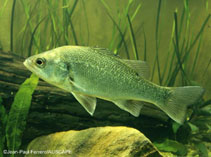
Klassifizierung / Names
Namen | Synonyme | Catalog of Fishes(Gattung, Arten) | ITIS | CoL | WoRMS | Cloffa
Umwelt: Milieu / Klimazone / Tiefenbereich / Verbreitungsgebiet
Ökologie
; süßwasser; brackwasser demersal; katadrom (Ref. 138269). Temperate; 10°S - 40°S
Oceania: endemic to Australia (Queensland to Victoria).
Größe / Gewicht / Alter
Geschlechtsreife: Lm ? range ? - ? cm
Max length : 60.0 cm TL Männchen/unbestimmt; (Ref. 6398); max. veröff. Alter: 22 Jahre (Ref. 38557)
Kurzbeschreibung
Bestimmungsschlüssel | Morphologie | Morphometrie
Adults occur in rivers and estuaries (Ref. 7300, 44894), lakes and small streams in upland and coastal plain areas, including brackish estuaries. They prefer the cover provided by aquatic vegetation in rocky or gravel-bottomed pools. Only females dwell upstream; males tend to stay in the lower, estuarine reaches of rivers. Juveniles feed on zooplankton; adult on insects, crustaceans and fishes. Life cycle is catadromous: flood events between May and August trigger a downstream spawning migration to estuaries. Plant thickets and sandbars are known sites for egg deposition (Ref. 44894). A 63 cm LCF female was caught and released in Lake Samsonvale, SE Queensland with an estimated weight of more than 4.5 kg (Stephen T. Poole, pers.comm. elops1@yahoo.com, 03/09).
Lebenszyklus und Paarungsverhalten
Geschlechtsreife | Fortpflanzung | Ablaichen | Eier | Fruchtbarkeit | Larven
Paxton, J.R., D.F. Hoese, G.R. Allen and J.E. Hanley, 1989. Pisces. Petromyzontidae to Carangidae. Zoological Catalogue of Australia, Vol. 7. Australian Government Publishing Service, Canberra, 665 p. (Ref. 7300)
IUCN Rote Liste Status (Ref. 130435: Version 2025-2 (Global))
Bedrohung für Menschen
Harmless
Nutzung durch Menschen
Fischereien: kommerziell; Sportfisch: ja
Tools
Zusatzinformationen
Download XML
Internet Quellen
Schätzungen auf der Grundlage von Modellen
Phylogenetischer Diversitätsindex (Ref.
82804): PD
50 = 1.0000 [Uniqueness, from 0.5 = low to 2.0 = high].
Bayesian length-weight: a=0.01096 (0.00421 - 0.02854), b=3.05 (2.83 - 3.27), in cm total length, based on LWR estimates for this (Sub)family-body shape (Ref.
93245).
Trophische Ebene (Ref.
69278): 3.4 ±0.5 se; based on size and trophs of closest relatives
Widerstandsfähigkeit (Ref.
120179): niedrig, Verdopplung der Population dauert 4,5 - 14 Jahre. (tmax=18; k=0.20).
Anfälligkeit der Fischerei (Ref.
59153): Moderate to high vulnerability (48 of 100).
🛈