Classification / Noms
Noms communs | Synonymes | Catalog of Fishes(Genre, Espèce) | ITIS | CoL | WoRMS | Cloffa
>
Cichliformes (Cichlids, convict blennies) >
Cichlidae (Cichlids) > Cichlinae
Etymology: Crenicichla: Latin, crenulatus = cut, clipped + Greek, kichle = wrasse (Ref. 45335); zebrina: From the common name zebra for the striped African equid and the Latin feminine suffix –
ina, referring to the zebra-like pattern of vertical dark bars in the caudal region of the body. To be regarded as an adjective in feminine form.
Environnement : milieu / zone climatique / profondeur / gamme de distribution
Écologie
; eau douce benthopélagique. Tropical; 4°N - 3°N
South America: Venezuela. Known only from the Ventuari River, the largest Venezuelan tributary of the upper Orinoco River basin (Ref. 78579).
Taille / Poids / Âge
Maturité: Lm ? range ? - ? cm
Max length : 26.4 cm SL mâle / non sexé; (Ref. 78579)
Description synthétique
Clés d'identification | Morphologie | Morphométrie
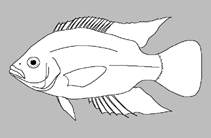
Épines dorsales (Total) : 22; Rayons mous dorsaux (Total) : 15; Épines anales: 3; Rayons mous anaux: 11; Vertèbres: 41. Crenicichla zebrina is distinguished from all congeners by its pigmentation pattern, which
includes the unique combination of a large, more or less oval-shaped humeral spot, and thin, dark vertical bars on the caudal half of the body which are separated by thinner yellowish vertical bars. It further differs from all other species in the C. acutirostris group except C. tigrina by a higher lateral scale count (E1=114 versus 111 or less). It can be distinguished from C. tigrina, by the presence of a large, non-ocellated humeral spot (versus no spot), lower dorsal spine counts (XXII versus XXIII–XXIV), and the presence of alternating light and dark colored bars restricted to approximately the caudal half of the body (vs. bars on all the body in C. tigrina).
Body shape (shape guide): elongated; Cross section: circular.
Cycle de vie et comportement reproducteur
Maturité | Reproduction | Frai | Œufs | Fécondité | Larves
Montaña, C.G., H. López-Fernández and D.C. Taphorn, 2008. A new species of Crenicichla (Perciformes: Cichlidae) from the Ventuari River, Upper Orinoco River Basin, Amazonas State, Venezuela. Zootaxa 1856:33-40. (Ref. 78579)
Statut dans la liste rouge de l'IUCN (Ref. 130435: Version 2025-2 (Global))
Menace pour l'homme
Harmless
Utilisations par l'homme
Outils
Articles particuliers
Télécharger en XML
Sources Internet
Estimations basées sur des modèles
Indice de diversité phylogénétique (Réf.
82804): PD
50 = 0.5000 [Uniqueness, from 0.5 = low to 2.0 = high].
Bayesian length-weight: a=0.00741 (0.00332 - 0.01655), b=3.11 (2.94 - 3.28), in cm total length, based on LWR estimates for this Genus-body shape (Ref.
93245).
Niveau trophique (Réf.
69278): 3.3 ±0.5 se; based on size and trophs of closest relatives
Résilience (Réf.
120179): Milieu, temps minimum de doublement de population : 1,4 à 4,4 années (Preliminary K or Fecundity.).
Vulnérabilité de la pêche (Ref.
59153): Low vulnerability (22 of 100).
🛈