Klassifizierung / Names
Namen | Synonyme | Catalog of Fishes(Gattung, Arten) | ITIS | CoL | WoRMS | Cloffa
>
Cypriniformes (Carps) >
Cyprinidae (Minnows or carps) > Smiliogastrinae
Etymology: Pethia: Pethia is the generic vernacular name for small cyprinids in Sinhala; padamya: Padamya is the Burmese word for ruby, given here with reference to the name ruby barb used in the ornamental fish trade, and to the bright red color of the males. It is to be treated as a noun in apposition.
More on authors: Kullander & Britz.
Umwelt: Milieu / Klimazone / Tiefenbereich / Verbreitungsgebiet
Ökologie
; süßwasser pelagisch. Tropical; 23°N - 21°N, 94°W - 96°W
Asia: Myanmar. Known only from the type locality, an artificial pond in Toe Gyi village, situated just above the Anisakan Falls, near Pyin Oo Lwin, on the road Mandalay-Hsipaw, and from the lower Chindwin River.
Größe / Gewicht / Alter
Geschlechtsreife: Lm ? range ? - ? cm
Max length : 4.6 cm SL Männchen/unbestimmt; (Ref. 79001)
Kurzbeschreibung
Bestimmungsschlüssel | Morphologie | Morphometrie
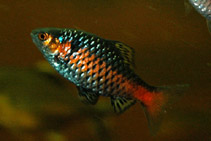
Rückenflossenweichstrahlen (insgesamt) : 11 - 12; Afterflossenweichstrahlen: 8. A member of the Puntius conchonius species group which can be distinguished from all its congeners in that group by a combination of the following characters: maxillary barbels present, minute; lateral line abbreviated, on 5-8 scales; circumpeduncular scales 12; dorsal, anal and pelvic fins in adult males hyaline, margined with black and crossed by two or three rows of contrasting deep black spots; humeral spot vertically elongate, three or more scales deep; caudal peduncle blotch covering parts of one or two scales, and indistinct in adult males. Similar only to P. didi, sharing abbreviated lateral line, presence of maxillary barbels, 12 circumpeduncular scales, and colour pattern including both vertically extended humeral blotch and caudal peduncle blotch, other vertical bars absent. Can be separated from P.didi in extension of humeral blotch which reaches ventrally to lateral line scales, vs. extending down to level of pectoral fin base in P. didi; in colour pattern of adult males in which sides yellowish white with contrasting brown blotches at scale bases and abdomen dark pigmented, vs. sides lightly pigmented, gradually lighter ventrally, abdomen whitish in males of P. didi; pelvic fins in males hyaline with two rows of deep black spots and deep black marginal band vs. pelvic fins either without dark markings or blackish marginal stripe and single row of black spots across middle of fin in P. didi; anal fin in males hyaline with deep black margin and two or three rows of deep black spots, vs. blackish margin and at most one row of blackish spots in P. didi; males with conspicuous red colour along middle of side from opercle to base of caudal fin vs. red colour absent from sides in males of P. didi (Ref. 79001).
Body shape (shape guide): short and / or deep.
Found in an artificial pond (Ref. 79001).
Lebenszyklus und Paarungsverhalten
Geschlechtsreife | Fortpflanzung | Ablaichen | Eier | Fruchtbarkeit | Larven
Kullander, S.O. and R. Britz, 2008. Puntius padamya, a new species of cyprinid fish from Myanmar (Teleostei: Cyprinidae). Electronic J. Ichthyol. (2):56-66. (Ref. 79001)
IUCN Rote Liste Status (Ref. 130435: Version 2025-2 (Global))
Bedrohung für Menschen
Harmless
Nutzung durch Menschen
Tools
Zusatzinformationen
Download XML
Internet Quellen
Schätzungen auf der Grundlage von Modellen
Phylogenetischer Diversitätsindex (Ref.
82804): PD
50 = 0.5000 [Uniqueness, from 0.5 = low to 2.0 = high].
Bayesian length-weight: a=0.01622 (0.00606 - 0.04338), b=2.94 (2.71 - 3.17), in cm total length, based on LWR estimates for this (Sub)family-body shape (Ref.
93245).
Trophische Ebene (Ref.
69278): 2.7 ±0.2 se; based on size and trophs of closest relatives
Widerstandsfähigkeit (Ref.
120179): hoch, Verdopplung der Population dauert weniger als 15 Monate. (Preliminary K or Fecundity.).
Anfälligkeit der Fischerei (Ref.
59153): Low vulnerability (10 of 100).
🛈